
In today’s world of cybersecurity and ethical hacking, one of the most critical steps is to gather information about a particular system, which is known as reconnaissance. Without proper reconnaissance, security experts face difficulties while protecting computer systems.
One of the most potent tools used for internet-wide reconnaissance is Censys, which helps cybersecurity experts, ethical hackers, and researchers discover assets that are exposed on the internet.
What is Censys?
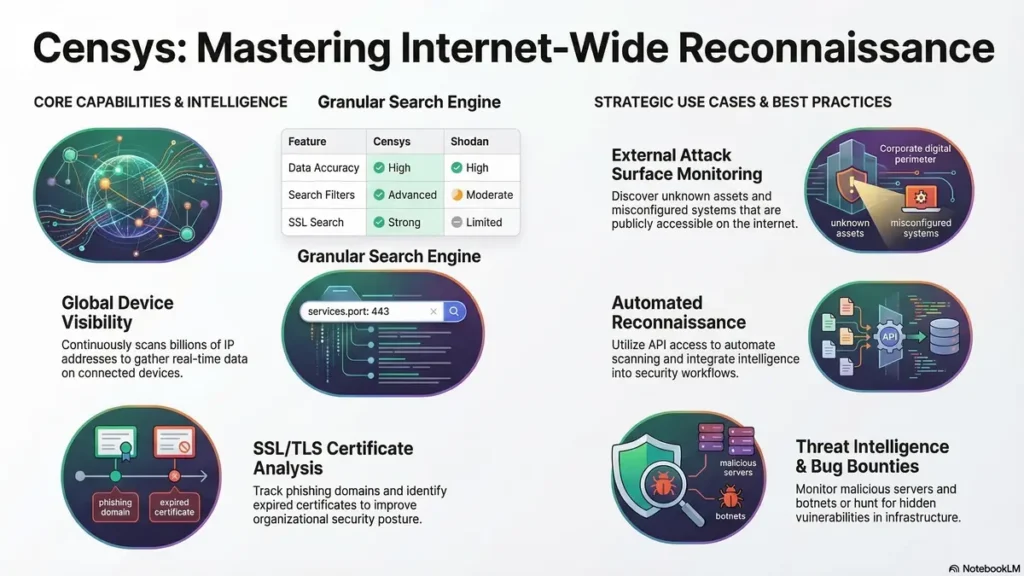
It is considered one of the best internet intelligence tools, which scans the entire internet and gathers information about devices, servers, certificates, etc. This tool enables users to search internet data to gather information about what is exposed on the internet.
Unlike other tools, which scan a particular domain,this intelligence gathering tool gives users a global view of the internet. This tool continuously scans IP addresses and domains to gather real-time data.
With help of this tool you can discover:
Open ports available on servers
SSL/TLS certificates
Exposure of databases
Web servers and technologies
IoT devices connected to the internet
This tool is considered one of the best tools for cybersecurity experts and ethical hackers.
Why Censys is Important in Cybersecurity
Censys is very important in the modern cybersecurity space. Most organizations are unaware that they are exposing critical systems on the internet. This tool helps in identifying these exposures.
1. Discover Exposed Assets
Censys helps you discover devices and services that are publicly accessible on the internet.
2. Improve Security Posture
Censys helps organizations monitor their own infrastructure and improve the security posture.
3. Threat Intelligence
Censys helps security teams monitor attackers, botnets, and malicious servers.
4. Bug Bounty Hunting
Bug bounty hunters use Censys to find misconfigured systems and hidden services.
Key Features
Censys is widely used because of its powerful features and user-friendliness.
1. Internet-Wide Scanning
Censys scans billions of internet-connected devices, gathering critical data.
2. Advanced Search Engine
Censys offers a powerful search engine in which the user can query the data using filters.
Example:
services.port: 443
In the above query, the user is finding systems running HTTPS services.
3. SSL/TLS Certificate Search
Censys enables users to search and analyze SSL certificates.
This is useful for:
Determining expired certificates
Identifying domains using similar certificates
Tracking phishing domains
4. Real-Time Data
Censys Data is updated regularly, thus enabling real-time data analysis.
5. API Access
Developers can use the API to automate their reconnaissance activities.
How This Information Gathering tool Works
This tool operates by scanning the internet continuously to gather data about devices and services.
This is done by:
Scanning IP addresses across the internet
Gathering data using open ports and services
Organizing data in a structured format
Creating a search interface
Users can then use various filters to search through the data and retrieve required information.
How to Use
It is simple to use and does not require any special technical expertise.
Step 1: Create an Account
You need to create a free account by visiting the Censys website.
Step 2: Use the Search Bar
You need to enter your search query to get specific information.
Example Search Query
Find HTTPS Servers
services.port: 443
Find Apache Servers
services.software: Apache
Step 3: Analyze Results
Censys will display a list of systems that match your search query.
You can click on a system to get more information such as:
IP Address
Open Ports
Services Running
Censys vs Shodan
Censys is often compared with another popular tool, called Shodan.
| Features | Censys | Shodan |
|---|---|---|
| Data Accuracy | High | High |
| Search Filters | Advanced | Moderate |
| SSL Search | Strong | Limited |
| Interface | Technical | User-Friendly |
Both tools are powerful, but Censys is preferred for deep technical analysis.
Use Cases
This information gathering tool is used in many real-world use cases related to cybersecurity.
1. Penetration Testing
Ethical hackers use of this tool is to gather information about the targeted system.
2. Asset Discovery
Organizations use this intelligence tool to discover unknown assets.
3. Vulnerability Detection
Security teams use to detect vulnerability.
4. Monitoring Attack Surface
Companies use to monitor their external attack surface.
Best Practices
For effective use of this information gathering tool, it is recommended that users adhere to the following best practices:
1. Always Use Legal Authorization
Use only on systems that you are authorized to test.
2. Combine with Other Tools
Use in combination with other tools such as:
Nmap
Sublist3r
Amass
3. Learn Query Syntax
Knowing how to use search queries will enable you to get better results.
4. Automate Using API
Use the API to automate your reconnaissance scans.
Limitations
Even though it is a powerful tool, it has some limitations:
Requires learning query syntax
Has limited access in the free version
The data may not be entirely real-time
However, It is still one of the best tools for use in internet intelligence.
Conclusion
This tool is one of the most powerful tools for use in internet-wide reconnaissance scans in the world of cybersecurity. It gives users in-depth insights into various devices that are connected to the internet.
Regardless of whether you are a beginner in the world of cybersecurity or a veteran in the field, learning how to use Censys will be instrumental in helping you become a better reconnaissance artist.
Frequently Asked Questions (FAQs)
1. What is an internet intelligence tool in cybersecurity?
An internet intelligence tool is a tool used in collecting data from internet-accessible devices, allowing cybersecurity experts to identify vulnerable systems.
2. How does internet-wide scanning function?
Internet-wide scanning involves scanning the internet continuously, allowing the collection of data on the available internet services.
3. What is reconnaissance in ethical hacking?
Reconnaissance is the collection of data on the systems before the process of penetration testing.
4. Why is asset discovery important in cybersecurity?
Asset discovery is important in the reduction of the risk of cyber attacks on organizations.
5. How do security researchers find open ports on servers?
Security researchers may employ the services of a scanner and search engines to identify open ports and services running on the internet.
6. What is the term for services that are exposed on the internet?
Exposed services refer to services or applications that are accessible via the internet and may be a target for an attacker if not properly secured.
7. How do ethical hackers identify vulnerabilities on the internet?
Ethical hackers may employ the services of a reconnaissance tool to identify potential vulnerabilities on the internet.
8. What is SSL/TLS certificate analysis?
SSL/TLS certificate analysis is a process of analyzing a digital certificate to identify potential risks.
9. How can certificate data help in cyber security?
The certificate data can help in tracking domains, identifying phishing attacks, and also in identifying shared infrastructures between various services.
10. What is attack surface monitoring?
The attack surface monitoring is a method of tracking all external assets as well as services that are exposed to the internet to minimize risks.
11. How do bug bounty hunters find targets?
The bug bounty hunters use their tools to find exposed systems, subdomains, as well as misconfiguration.
12. What is the role of search filters in cyber security tools?
The search filters help in searching a particular system, service, as well as configurations according to the requirements of the user.
13. How can organizations improve their security posture?
Organizations can improve security posture by identifying exposed assets, fixing vulnerabilities, and continuously monitoring their infrastructure.
14. What are internet-connected devices in cybersecurity?
Internet-connected devices include servers, databases, IoT devices, and applications that are accessible through the internet.
15. How does real-time data help security teams?
Real-time data allows security teams to detect threats quickly and respond to vulnerabilities before attackers exploit them.
16. What is vulnerability detection?
Vulnerability detection is the process of identifying weaknesses in systems, applications, or networks that could be exploited by attackers.
17. How can APIs help in reconnaissance?
APIs allow automation of data collection and analysis, making reconnaissance faster and more efficient.
18. What is the difference between passive and active reconnaissance?
Passive reconnaissance collects data from public sources without interacting with the target, while active reconnaissance involves direct interaction with the system.
19. How do cybersecurity tools help in threat intelligence?
Cybersecurity tools collect and analyze data to identify malicious activities, attackers, and potential threats across the internet.
20. Why is monitoring internet exposure important?
Monitoring internet exposure helps organizations detect misconfiguration and prevent unauthorized access to sensitive systems.
21. What is a subdomain enumeration tool in cybersecurity?
A subdomain enumeration tool is used to discover subdomains of a target domain, helping security professionals identify hidden services, applications, and potential vulnerabilities exposed on the internet.
Friends,
I’ve started Coding Journey to share tech knowledge, cybersecurity awareness, digital marketing tips, and practical tutorials to help everyone grow safely in the digital world.
If you find value in learning about:
✅ Linux & Cybersecurity
✅ Digital Marketing & SEO
✅ Online safety & scam awareness
✅ Practical tech guides
I’d really appreciate your support and follow 🙏
🔗 Official Website & Blog
🌐 https://codingjourney.co.in
📝 https://codingjourney1983.blogspot.com
🔗 Follow on Social Media
🔵 Facebook: https://www.facebook.com/people/Coding-journey/61585197473575/
💼 LinkedIn: https://www.linkedin.com/in/sunil-kumar-tiwari-07b8b466
🐦 X (Twitter): https://x.com/suniltiwari4509
📸 Instagram: https://www.instagram.com/coding9529/
📌 Pinterest: https://in.pinterest.com/codingjourney1983/
❓ Quora: https://www.quora.com/profile/Sunil-4966
✍️ Medium: https://medium.com/@codingjourney1983
Your one follow, like, or share really motivates me to create more helpful content 💙
Thank you for supporting Coding Journey 🙌
Let’s learn, grow, and stay secure together.
Related Posts
 DeHashed: Complete Guide for Cybersecurity, OSINT & Breach Intelligence (2026)
In the field of cybersecurity, data leaks, and digital investigations, DeHashed is a powerful and…
 Subfinder: Best Subdomain Enumeration Tool for Ethical Hackers(2026)
In the field of cybersecurity or ethical hacking, reconnaissance plays an important role. Before performing…
 Sublist3r: A Powerful Subdomain Enumeration Tool
In the world of cybersecurity and Ethical Hacking, reconnaissance is the first and most important…
 Best Subdomain enumeration tool: Bug Bounty Weapon for 2026
Best subdomain enumeration tool is an essential part of every cybersecurity professional’s or ethical hacker’s…