
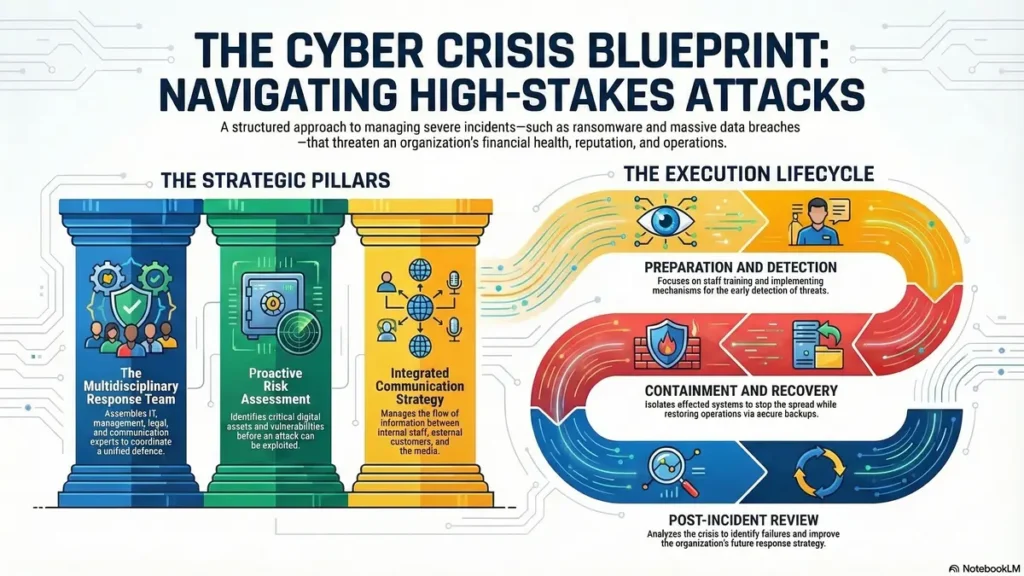
What is a Cyber Crisis Management Plan(CCMP)?
It is a structured plan that assists in planning for and managing cyber crises such as hacking, data breaches, ransomware attacks, and system failures.
This ensures that in case a serious cyber attack occurs in an organization, it will be able to respond to it in a timely and effective manner.
What is a Cyber Crisis?
A cyber crisis is a situation that occurs when a cyber attack:
Disrupts critical operations in an organization or country.
Leads to significant loss or theft of data.
Has significant implications for national security and business operations.
Leads to damage to reputation and financial well-being.
Some examples of cyber crises include:
Ransomware attack that causes systems to shut down.
Significant data breach.
Attack on critical infrastructure.
What are the Objectives of a CCMP?
The main objectives are:
To minimize damage caused by cyber crises.
To ensure a timely and effective response and recovery from cyber crises.
To ensure that sensitive data and systems are protected.
To ensure business operations continue as usual.
⚙️ Key Components
1. Incident Response Team (IRT)
A group of people responsible for managing cyber crises
This group comprises IT experts, management staff, legal experts, and communication experts
2. Risk Assessment
Identifies potential cyber threats and vulnerabilities
Identifies critical assets that need protection
3. Incident Detection and Reporting
Mechanism for early detection of cyber incidents
Reporting mechanisms in place
4. Response Strategy
Step-by-step action plan to control and manage the cyber attack
Isolation of systems from the rest of the systems in the organization
5. Communication Plan
Communication with internal parties such as employees and management
Communication with external parties such as customers and the media
7. Legal and Compliance Actions
Adhering to laws and regulations
Reporting the incident to the relevant authorities
8. Post-Incident Review
Determining what went wrong
Improving the response for the future
🔄 Phases of Cyber Crisis Management
Preparation – Planning and training
Detection – Detecting the attack
Response – Containing the attack
Recovery – Recovery
Review – Learning and improvement
🏢 Importance
Prevents chaos during cyber attacks
Avoids financial and reputational losses
Facilitates timely decisions
Improves the resilience of the organization
🧠 Simple Explanation
👉 A Cyber Crisis Management Plan is like a “fire drill plan for cyber attacks”
It explains:
Who needs to act
What needs to be done
How to quickly recover
📌 Example
If a company is hit with ransomware:
CCMP activates the response team
Systems are isolated
Data from the backup is used
Communication is managed
Frequently Asked Questions (FAQs)
1. What is a Cyber Crisis Management Plan?
A CCMP is a structured approach that helps organizations prepare for, respond to, and recover from cyber incidents effectively.
2. Why is a Cyber Crisis Management Plan important?
It helps organizations minimize damage, maintain operations, and recover quickly during cyber attacks.
3. What is included in a Cyber Crisis Management Plan?
It includes incident response procedures, communication plans, recovery strategies, and roles of team members.
4. Who is responsible for implementing a CCMP?
A dedicated incident response team, including IT professionals, management, and legal experts, is responsible.
5. What types of incidents require a Cyber Crisis Management Plan?
Incidents like ransomware attacks, data breaches, system failures, and cyber espionage require such a plan.
6. How does a Cyber Crisis Management Plan help in data protection?
It ensures quick response and containment, reducing the risk of data loss or theft.
7. What is the role of an incident response team in a Cyber Crisis Management Plan?
The team detects, analyzes, and responds to cyber incidents to minimize damage.
8. How can organizations prepare for cyber crises?
Organizations can prepare by conducting risk assessments, training staff, and developing a detailed response plan.
9. What is the difference between incident response and crisis management?
Incident response focuses on handling the attack, while crisis management deals with overall impact and recovery.
10. How does communication play a role in a Cyber Crisis Management Plan?
It ensures clear and timely information sharing with employees, customers, and authorities.
11. What is risk assessment in a Cyber Crisis Management Plan?
Risk assessment identifies potential threats and vulnerabilities in an organization’s systems.
12. How does a Cyber Crisis Management Plan support business continuity?
It ensures that critical operations continue or resume quickly after an attack.
13. What are the phases of a Cyber Crisis Management Plan?
The phases include preparation, detection, response, recovery, and review.
14. How often should a Cyber Crisis Management Plan be updated?
It should be updated regularly based on new threats, technologies, and lessons learned from incidents.
15. What is post-incident review in a Cyber Crisis Management Plan?
It is the process of analyzing the incident to improve future response strategies.
16. How can automation improve a Cyber Crisis Management Plan?
Automation helps in faster detection, response, and mitigation of cyber threats.
17. What role does training play in a Cyber Crisis Management Plan?
Training ensures that employees know how to respond effectively during a cyber crisis.
18. How does a Cyber Crisis Management Plan reduce financial loss?
It minimizes downtime, prevents data loss, and reduces recovery costs.
19. What are common challenges in implementing a Cyber Crisis Management Plan?
Challenges include lack of awareness, insufficient resources, and outdated procedures.
20. How can small businesses benefit from a Cyber Crisis Management Plan?
It helps them protect data, maintain operations, and respond effectively to cyber threats.
Here is your content formatted cleanly for WordPress (FAQ style with proper headings and spacing) without changing a single word:
21. What is the purpose of an incident response strategy in cybersecurity?
An incident response strategy helps organizations quickly detect, respond, and recover from cyber threats like data breaches, malware attacks, and system compromises.
22. How can organizations prepare for ransomware attacks effectively?
Organizations can prepare by maintaining regular backups, implementing strong endpoint security, training employees, and having a well-defined response framework.
23. Why is risk assessment important in information security planning?
Risk assessment identifies vulnerabilities and potential threats, allowing businesses to prioritize security measures and reduce the impact of cyber incidents.
24. What role does a disaster recovery plan play in cyber incidents?
A disaster recovery plan ensures that critical systems and data can be restored quickly after an attack, minimizing downtime and business disruption.
25. How does employee awareness improve digital threat management?
Employee awareness reduces human errors like phishing clicks and weak password practices, which are common entry points for cyber attackers.
26. What are the key components of an effective breach response framework?
The key components are detection, containment, eradication, recovery, communication, and post-incident analysis.
27. How can businesses ensure data protection during security incidents?
Businesses can protect their data by using techniques like encryption and access control mechanisms, which provide data protection even in the face of security incidents.
28. What is the importance of real-time monitoring in threat mitigation?
Real-time monitoring is very important as it helps in the early detection of abnormal activities, which can limit the damage done by the threats.
29. How often should organizations review their cybersecurity preparedness plans?
Organizations should review their cybersecurity preparedness plans every 6–12 months or at least after every major security incident.
30. What tools are commonly used for managing cybersecurity incidents?
Commonly used tools are SIEM systems, intrusion detection systems, endpoint protection platforms, and threat intelligence tools.
🌟 Stay Connected with Coding Journey 🌟
Friends,
I’ve started Coding Journey to share tech knowledge, cybersecurity awareness, digital marketing tips, and practical tutorials to help everyone grow safely in the digital world.
If you find value in learning about:
✅ Linux & Cybersecurity
✅ Digital Marketing & SEO
✅ Online safety & scam awareness
✅ Practical tech guides
I’d really appreciate your support and follow 🙏
🔗 Official Website & Blog
🌐 https://codingjourney.co.in
📝 https://codingjourney1983.blogspot.com
🔗 Follow on Social Media
🔵 Facebook: https://www.facebook.com/people/Coding-journey/61585197473575/
💼 LinkedIn: https://www.linkedin.com/in/sunil-kumar-tiwari-07b8b466
🐦 X (Twitter): https://x.com/suniltiwari4509
📸 Instagram: https://www.instagram.com/coding9529/
📌 Pinterest: https://in.pinterest.com/codingjourney1983/
❓ Quora: https://www.quora.com/profile/Sunil-4966
✍️ Medium: https://medium.com/@codingjourney1983
Your one follow, like, or share really motivates me to create more helpful content 💙
Thank you for supporting Coding Journey 🙌
Let’s learn, grow, and stay secure together.
Related Posts
 Cyber Security Jobs in 2026: Roles, Skills & Career Growth
Table of Contents Introduction Why Cyber Security Jobs Are in High Demand Top Cyber Security…
 Cyber Security Salary 2026:Expert Tips to Maximize Your Pay
Table of Contents Introduction What Is a Cyber Security Salary? Average Cyber Security Salary in…
 Entry Level Cyber Security Jobs thriving: Your Complete 2026 Guide to Launching a Career
Table of Contents Introduction Why Choose Entry Level Cyber Security Jobs? Top Entry Level Cyber…
 10 Powerful Operational Security Strategies to Protect Data
Operational Security (OPSEC) is more important than ever as cyber threats increase in frequency and…

