
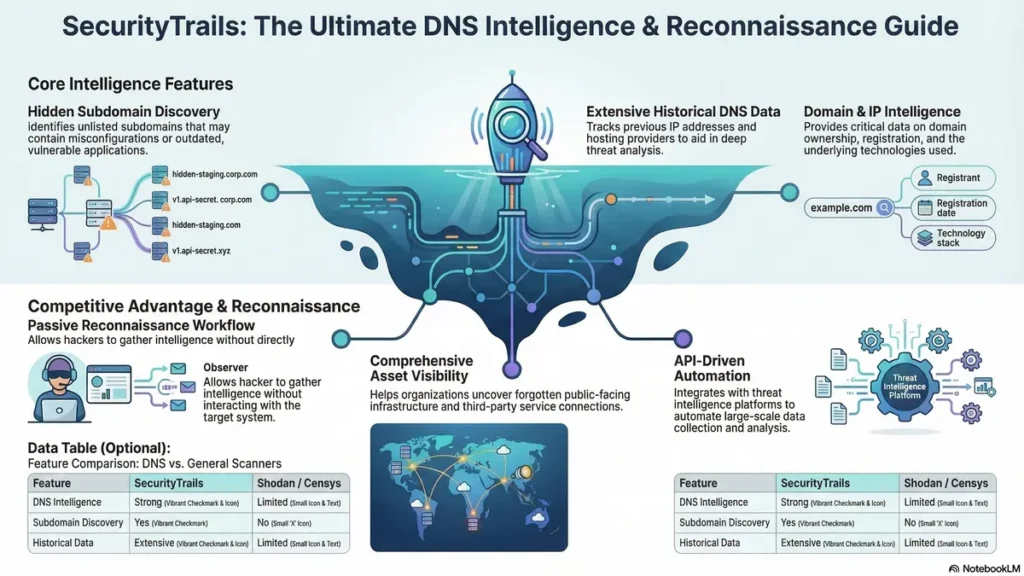
In today’s digital world, knowing what is available on the internet is one of the most powerful advantages that can be leveraged in cybersecurity. You can be an ethical hacker, penetration tester, security analyst, or even a business owner. Knowing what is available on the internet is crucial for you. SecurityTrails is one such platform that can help you achieve this. In this guide, you can learn what SecurityTrails is, its features and uses, its advantages, and how it can help you in ethical hacking and cybersecurity.
What is SecurityTrails?
SecurityTrails is a DNS intelligence and cybersecurity platform that can help users get detailed information about domains, IP addresses, DNS records, and other internet assets.
In other words, what SecurityTrails does is:
Retrieve all DNS records for a domain
Detect subdomains
Access historical data for domains
Analyze IP and hosting data
Reconnaissance for ethical hacking
Why SecurityTrails is Important in Cybersecurity
Generally, cybersecurity is not just about keeping your systems and data secure, but also about understanding your attack surface. In fact, many organizations are unaware of the number of assets they have exposed on the Internet.
What SecurityTrails does is to help organizations gain visibility into:
Public-facing infrastructures
Hidden subdomains
Historical DNS changes
Third-party services connected to domains
This is what makes SecurityTrails a great tool for:
Ethical hackers
Bug bounty hunters
SOC teams
Security researchers
Key Features
1. DNS Records Lookup
SecurityTrails offers access to the following DNS records:
A records
MX records
NS records
TXT records
These records are extremely valuable in assessing how the domain is set up.
2. Historical DNS Data
One of the most powerful features is access to historical data:
Old IP address
Old hosting provider
Old configurations
This is extremely valuable for investigation and threat analysis.
3. Subdomain Discovery
SecurityTrails enables you to discover hidden subdomains of a domain.
Example:
admin.example.com
dev.example.com
api.example.com
These subdomains may have vulnerabilities if not configured properly.
4. Domain Intelligence
It provides information about:
Domain ownership
Registration
Hosting provider
Technologies used
This is used for footprinting and reconnaissance.
5. API Access
SecurityTrails provides an API that helps developers and security teams automate data collection and analysis.
This is useful for:
Security automation
Threat intelligence platforms
Custom dashboards
How SecurityTrails Helps in Ethical Hacking
SecurityTrails plays a significant role in the reconnaissance phase of Ethical Hacking.
Step-by-Step Usage:
Enter domain
Analyze DNS records
Extract subdomains
Check historical IP data
Identify possible attack points
This helps Ethical Hackers:
Identify attack surface
Identify hidden assets
Identify misconfigurations
Use Cases of SecurityTrails
1. Penetration Testing
Security experts use it as a way of gathering intelligence prior to testing.
2. Bug Bounty Hunting
It helps in the detection of unknown subdomains, which might have vulnerabilities.
3. Threat Intelligence
It can be used to track malicious domains.
4. Asset Discovery
Organizations can use it as a way of detecting unknown assets.
5. Cyber Investigations
It can be used in tracking the ownership of domains.
SecurityTrails vs Other Tools
SecurityTrails is often compared and contrasted with the following tools:
Tools
Censys
Shodan
Difference
| Features | SecurityTrails | Censys | Shodan |
|---|---|---|---|
| DNS Intelligence | ✅ Strong | ❌ Limited | ❌ Limited |
| Subdomain Discovery | ✅ Yes | ❌ No | ❌ No |
| Historical Data | ✅ Extensive | ❌ Limited | ❌ Limited |
| Device Scanning | ❌ NO | ✅Yes | ✅Yes |
Benefits
Easy to use interface
Accurate and large dataset
Powerful for reconnaissance
Saves time in manual research
Helps identify hidden vulnerabilities
Limitations of SecurityTrails
Limited free plan
API usage can be costly
Does not scan live devices like Shodan
How to Get Started
Follow these simple steps:
Visit the official website
Create a free account
Enter a domain name
Explore DNS, subdomains, and history
For advanced usage, you can upgrade to a paid plan and use API features.
SEO & Digital Marketing Use
SecurityTrails is not just limited to cybersecurity. It can be useful in SEO as well.
You can:
Analyze your competitors’ domains
Find related sites
Track domain changes
Find hosting patterns
This will give marketers a competitive advantage in digital marketing.
Pro Tips
Integrate it with other tools such as Nmap and Burp Suite
Always check historical data for potential hidden data
Make use of subdomains for further analysis
Automate your queries for more efficiency using the API
Conclusion
SecurityTrails is a great and vital tool for anyone in cybersecurity, ethical hacking, or digital research. Its ability to provide in-depth DNS analysis is what differentiates it from other tools in the field.
Whether you are a newbie or a pro, using this tool will greatly enhance your capabilities.
FREQUENTLY ASKED QUESTIONS
1. What does DNS Intelligence mean in the context of Cybersecurity?
DNS Intelligence refers to the process of collecting data related to the domain name, IP addresses, and hosting.
2. How does Domain Intelligence help in Ethical Hacking?
Domain Intelligence helps the ethical hacker during the reconnaissance phase.
3. What does Subdomain Enumeration mean, and why is it important?
Subdomain Enumeration refers to the process of enumerating the subdomains of the domain name, which helps the ethical hacker identify the hidden entry points.
4. How does DNS help the Ethical Hacker during the reconnaissance phase?
DNS provides the details of the domain name, including the mail server, hosting, and verification.
5. What is the role of historical DNS data in investigations?
Historical DNS data assists investigators in tracking previous configurations, IP addresses, and hosting.
6. How can organizations identify hidden digital assets?
Organizations can identify unknown assets using domain and DNS analysis tools.
7. What is attack surface mapping in cybersecurity?
Attack surface mapping refers to the process of identifying all the potential entry points used by attackers.
8. How does IP intelligence support threat analysis?
IP intelligence assists investigators in tracking hosting providers, geolocation, and suspicious activities associated with the IP.
9. Why is reconnaissance important in penetration testing?
The importance of reconnaissance in penetration testing is to increase the possibility of identifying weaknesses in the target system.
10. What tools are used for DNS and domain analysis?
The common tools used in DNS and domain analysis are DNS lookup services, OSINT services, and network scanning services, which are used by cybersecurity professionals.
11. How can subdomains expose vulnerabilities?
Subdomains can be exposed to various cyberattacks due to outdated applications and services.
12. What is the importance of threat intelligence platforms?
The importance of threat intelligence platforms is to monitor malicious domains, attackers, and cyber threats.
13. How does DNS monitoring improve security?
DNS monitoring can improve security by monitoring suspicious changes in domain configurations.
14. What is passive reconnaissance in cybersecurity?
Passive reconnaissance is the collection of information without directly engaging the target system.
15. How can businesses gain better visibility of their online assets?
Businesses can achieve this through regular scanning of their domains and keeping their asset inventory up to date.
16. What is the difference between active and passive reconnaissance?
Active reconnaissance involves interaction with the target system, while passive reconnaissance involves the collection of publicly available information.
17. How can domain history aid in cyber threat detection?
Domain history can aid in the detection of cyber threats.
18. What is OSINT in cybersecurity?
OSINT is a collection of data available in the public domain for analysis in cybersecurity.
19. How do cybersecurity analysts identify malicious domains?
Domain intelligence, threat feeds, and pattern analysis are used to identify malicious domains.
20. Why is automation significant in data analysis in cybersecurity?
Automation is significant in data analysis in cybersecurity due to efficiency in processing large data.
🌟 Stay Connected with Coding Journey 🌟
Friends,
I’ve started Coding Journey to share tech knowledge, cybersecurity awareness, digital marketing tips, and practical tutorials to help everyone grow safely in the digital world.
If you find value in learning about:
✅ Linux & Cybersecurity
✅ Digital Marketing & SEO
✅ Online safety & scam awareness
✅ Practical tech guides
I’d really appreciate your support and follow 🙏
🔗 Official Website & Blog
🌐 https://codingjourney.co.in
📝 https://codingjourney1983.blogspot.com
🔗 Follow on Social Media
🔵 Facebook: https://www.facebook.com/people/Coding-journey/61585197473575/
💼 LinkedIn: https://www.linkedin.com/in/sunil-kumar-tiwari-07b8b466
🐦 X (Twitter): https://x.com/suniltiwari4509
📸 Instagram: https://www.instagram.com/coding9529/
📌 Pinterest: https://in.pinterest.com/codingjourney1983/
❓ Quora: https://www.quora.com/profile/Sunil-4966
✍️ Medium: https://medium.com/@codingjourney1983
Your one follow, like, or share really motivates me to create more helpful content 💙
Thank you for supporting Coding Journey 🙌
Let’s learn, grow, and stay secure together.
Related Posts
 Subfinder: Best Subdomain Enumeration Tool for Ethical Hackers(2026)
In the field of cybersecurity or ethical hacking, reconnaissance plays an important role. Before performing…
 Findomain: The Fastest Subdomain Enumeration Tool
In the world of cybersecurity and ethical hacking, reconnaissance is the first and the most…
 Best Subdomain enumeration tool: Bug Bounty Weapon for 2026
Best subdomain enumeration tool is an essential part of every cybersecurity professional’s or ethical hacker’s…
 Sublist3r: A Powerful Subdomain Enumeration Tool
In the world of cybersecurity and Ethical Hacking, reconnaissance is the first and most important…