
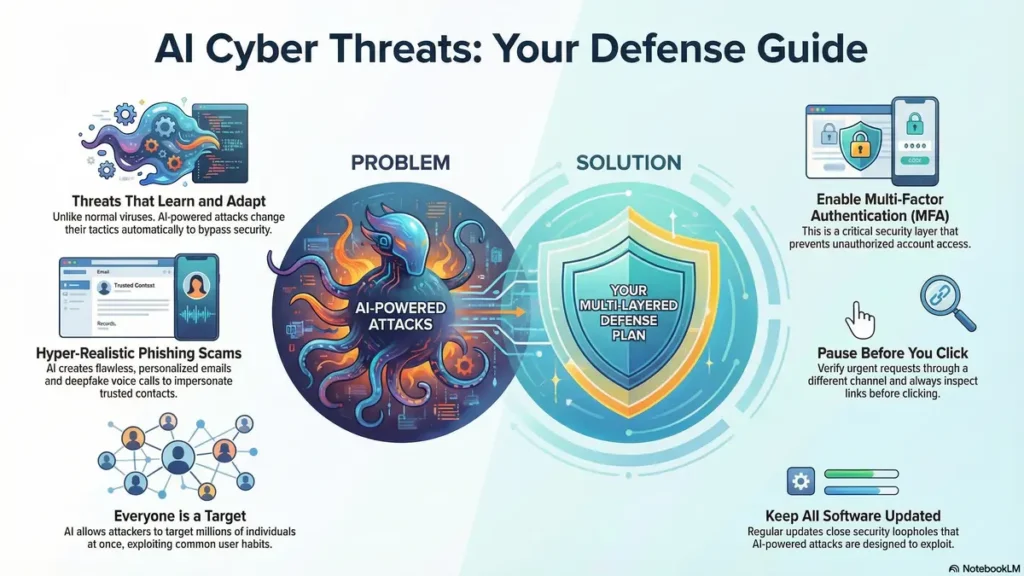
AI powered cybersecurity threats are growing silently and rapidly, affecting ordinary users, offices, and large organizations alike. Such threats employ artificial intelligence to understand, adjust, and harm faster than typical security systems can respond.
One of the factors that make these assaults more lethal is that they frequently remain unrecognized until a substantial type of damage has already been done. A lot of people think that cyber security attacks only happen to experts, however, AI-driven attacks are intended to take advantage of the normal online activities of people.
This article breaks down the real dangers of AI-powered cyber threats to anyone without technical knowledge. You will understand how these threats operate, who is vulnerable, and what definite measures you can take to secure yourself well in advance.
Table of Contents
- AI Powered Cybersecurity Threats and What They Really Mean
- AI Powered Cybersecurity Threats and How They Work Silently
- AI Powered Cybersecurity Threats You May Already Face Daily
- AI Powered Cybersecurity Threats Using Intelligent Malware
- AI Powered Cybersecurity Threats Through Smart Phishing Attacks
- AI Powered Cybersecurity Threats Driven by Ransomware
- AI Powered Cybersecurity Threats Targeting Common Users
- AI Powered Cybersecurity Threats and How to Detect Them Early
- AI Powered Cybersecurity Threats and How to Protect Yourself
- AI Powered Cybersecurity Threats and What to Do After an Attack
AI Powered Cybersecurity Threats and What They Really Mean
AI powered cybersecurity threats are the ones in which attackers use artificial intelligence to enhance the speed, accuracy, and the decision on the fly of the attack.
- AI-Driven Attacks – The operations that change itself according to the user’s behavior.
- Automated Decision Making – AI undoubtedly selects the most effective attack method.
- Learning Capability – The attack gets better with each time it tries.
In contrast to ordinary cyber threats, AI powered cybersecurity threats are not dependent on a set of rules. They learn from their failures and change their tactics automatically.
With this learning feature, the attackers can get through very simple security tools which they have already set aside.
Comprehending what these threats are is the way to shield yourself against such invisible and clever cyber attacks.
AI Powered Cybersecurity Threats and How They Work Silently
AI powered cybersecurity threats are structured to remain unnoticed when they are gathering data or if they are in the process of launching bigger attacks.
- Behavior Monitoring – AI observes how users click, type, and browse.
- Adaptive Timing – The attacks occur when users are the most inattentive.
- Minimal Footprint – The malware is of such a kind that it does not provoke security alarms.
- Email Scams – Communications that flawlessly imitate real interactions.
- Fake Websites – AI-created sites that appear totally authentic.
- Account Takeovers – AI infers passwords from user patterns.
- Self-Learning Malware – Learns from the failures of its attacks and gets better without any external intervention.
- Adaptive Behavior – Changes its operations in order to be unnoticed by security tools.
- Silent Data Theft – Takes information gradually so that it does not raise any suspicions.
- Perfect Language Use – AI produces error-free, professional communications.
- Personalized Content – Emails are customized through the use of stolen personal data.
- Realistic Conversations – AI can pick up the reply and continue like a real human.
- AI selects targets that will probably give a fast payment.
- The data is encrypted in a very clever way so that the scared reaction is of maximum intensity.
- The price varies according to the behavior of the victim.
- Ransomware powered by AI can wait a while before it can be detected by the security system.
- AI-fabricated phishing emails falsely representing a bank or a delivery service, with flawless language and using personal details that are taken from social media.
- Malicious “system optimizer” or “free antivirus” tools created and advertised by AI that, in the background, install data-stealing malware without the user’s knowledge.
- Emails fabricated by AI that not only copy the style of the company but also refer to the real projects, thus, deceiving employees into clicking on links or uploading documents to fake “SharePoint/Drive” folders.
- Deepfake voice calls pretending to be managers, and asking employees in an urgent manner for sharing files or going around the usual approval steps.
- “AI homework helper” or “free course” services that require credentials and then use them to get access to school portals and cloud storage.
- Artificially generated emails offering fake internships or scholarships that direct users to phishing pages where the attackers collect IDs and payment information.
- AI-created job proposals on platform accounts with the presence of macro malware or links for stealing credentials included in contracts and invoices.
- Chatbot-enabled “clients” who convince freelancers to run “test tools” while in reality, these are remote access trojans.
- AI-personalized advertisements for “aimbots” or “free skins” are the means through which malware that steals game and platform logins is spread.
- AI bots in game chats that send convincing links to fake tournaments or reward sites that are actually phishing sites to get credentials.
- AI-supported SMS and email phishing that smoothly imitate bank alerts and change the wording dynamically if the user shows hesitation or asks questions.
- Deepfake voice calls that pretend to be bank support and guide the victims step-by-step through the fake “verification” which is actually capturing OTPs and 2FA codes.
- Invoices or payment requests made through AI that are identical to the real ones from suppliers, with the only difference being the bank account number.
- Compromised email threads where AI keeps the existing conversations going and, in the authentic-looking response, it inserts the malicious link.
- AI-built fake e-commerce sites that have realistic reviews, product descriptions, and chatbots that accept payments but don’t deliver goods.
- Phishing pages that are dynamic and can change their appearance in real-time to match the victim’s device and language to trick them into giving their card details.
- AI-driven “trading bots” or signal groups that, after installation, secretly send wallet keys and API keys to the creators.
- Deepfake videos of influencers or CEOs that are used to promote fake token sales or investment portals.
- Highly targeted spear-phishing that references real invoices, vendors, and amounts mined from data, thus deceiving the recipients into changing payment details.
- Deepfake voice or video calls from “CFOs” that request urgent large transfers to attacker-controlled accounts.
- Malicious CVs or portfolios created by AI that have embedded malware or links to weaponized “candidate sites”.
- AI emails that pretend to be job platforms and ask HR to “re-authenticate” accounts on phishing pages.
- AI-created pull requests or “code snippets” that have hidden backdoors and look legitimate at the first glance.
- AI chatbots that provide technical answers but include harmful commands or insecure configurations.
- Brand-collab fake emails where AI imitates the tone of the real PR agency and asks them to install a “media kit viewer” which is malware.
- AI-generated phishing pages that pretend to be YouTube/Instagram login for “copyright strikes” and thus, steal accounts.
- AI-personalized emails that pretend to be from hospital IT or regulators, with malicious attachments that are labeled as policy or lab results.
- On the fake medical portals, chatbots that convince staff to provide VPN or EHR credentials.
- AI-created “client” messages that contain realistic case details and bundles of malicious documents.
- Deepfake audio of “partners” instructing them to share confidential files through links that the attackers control.
- Parent or admin emails written by AI and containing links to fake “grade submission” or “exam schedule” portals.
- Free “AI teaching tools” that secretly copy class lists, emails, and school network credentials.
- Messages from donors or grants that are crafted by AI and have malicious attachments that are disguised as proposals or donor lists.
- Locally generated by AI, fake campaign pages are designed to capture personal information of volunteers and donors.
- Recruiter messages generated by AI that contain links to realistic but fake application portals which steal IDs, resumes, and login data.
- Deepfake interview calls where “HR” requests the installation of remote interview software and thus, gaining remote access to their device.
- AI voice cloning calls that mimic family members or doctors and request for urgent payments or access codes.
- Adaptive scam emails that simplify language, change the tone, and follow up on trust through phone and SMS.
- AI bots that make friendships with users, talk naturally, and then push them to click on malicious links or invest in scams.
- Artificially created fake login requests in the duplicated social platforms that take passwords and 2FA tokens.
- Behavior Anomalies – Significantly altered login times, locations, or usage.
- Unusual Network Activity – Unexpected transfers of data or spikes.
- Account Alerts – Numerous failed logins or password reset attempts.
- Behavior-Based Security – Identifies attacks through behaviors, not signatures.
- Email Filtering – Prevents AI-generated phishing emails from reaching users.
- Multi-Factor Authentication – Prevents the hijacking of accounts.
- Isolate Systems – Detach the affected devices from the networks.
- Preserve Evidence – Do not remove logs or files.
- Notify Authorities – Tell IT or cybersecurity experts.
- Context Mismatch – Incomprehensible requests for usual workflows.
- Link Inspection – Hover to check the URLs.
- Sender Verification – Confirm with a different communication method.
- Process Monitoring – Detect strange or unusual background processes.
- Resource Spikes – Unanticipated CPU or memory consumption.
- Unauthorized Changes – What’s new services or startup items?
- File Renaming – Extensions changing without user interaction.
- Access Delays – Files opening with a delay or not opening at all.
- Shadow Copy Deletions – Attempts to remove backups.
- Strong Passwords – Different and lengthy passwords.
- MFA Everywhere – Mainly for email and finance.
- Login Alerts – Immediate notifications.
- Pause Before Clicking – Don’t fall for the trap of urgency.
- Verify Requests – This is most important in case of payments or data.
- Limit Oversharing – Help to lower the exposure of your data.
- Fake Voice Calls – AI replicates the voices of managers or family members.
- Fake Video Messages – Realistic videos are used to request urgent actions.
- Identity Impersonation – The use of trusted identities for the purposes of impersonation.
- Rapid Scanning – Thousands of systems checked quickly.
- Exploit Selection – AI chooses the best attack path.
- Continuous Attacks – Exploits repeat until successful.
- Distributed Control – The compromised devices coordinate their activities.
- Traffic Flooding – The targeted systems are flooded with requests.
- Stealth Coordination – The attacks vary their patterns automatically.
- Smarter Automation – The attack operations require less human intervention.
- More Personalization – The victims are targeted most accurately.
- Wider Scale – Several millions can be attacked simultaneously.
- Layered Security – A mix of tools and habits.
- Training – Continuous awareness sessions.
- Incident Planning – Having the knowledge of what to do before the attacks.
Such threats are very often figuratively “sleeping” in the targeted systems until the suitable moment comes and therefore are hard to detect.
Since the assault adjusts to the user’s behavior, regular antivirus software might not detect it right away.
The very fact that these attackers use a silent mode is the reason why AI-powered cybersecurity threats are considered to be more dangerous than those that have existed before.
AI Powered Cybersecurity Threats You May Already Face Daily
In their everyday online activities, a lot of people are unaware that they are interacting with AI-powered cybersecurity threats.
Such dangers are not constantly seeming as shady, thus they are more efficient.
Cybercriminals employ AI to make the attacks more targeted, thereby the posibility of the accomplishment is elevated.
AI Powered Cybersecurity Threats Using Intelligent Malware
AI powered threats in the cybersecurity realm have now evolved into intelligent malware that is capable of thinking, adapting, and hiding more efficiently than traditional malicious software.
Where traditional malware is hardcoded with instructions, AI-powered malware modifies itself according to the defenses of the system.
Therefore, it is quite hard to detect the malware since it will behave differently on each system.
Recognizing such a threat is the first step towards safety in an AI-driven cyber world.
AI Powered Cybersecurity Threats Through Smart Phishing Attacks
Phishing assaults utilizing AI are significantly more convincing and hazardous than traditional scam emails.
These phishing communications frequently being able to se the mails of a bank, office or trusted contact which are sent to you but actually phishing ones.
AI analyzes social media and previous emails to impersonate the writing style.
That is why AI driven cybersecurity threats are so powerful against the average users.
AI Powered Cybersecurity Threats Driven by Ransomware
Ransomware assaults that use AI are more efficient, intelligent, and they can cause more damage than a conventional ransomware.
However, it can also infect different machines before showing itself.
That’s why AI-powered cyber threats are so tough to fight.
AI Powered Cybersecurity Threats Targeting Common Users
AI cyber-attacks have become the new normal for everyday users of almost any kind of technology, their target is no longer only big companies or governments.
Home users
Office workers
Students
Freelancers
Online gamers
Online banking users
Small business owners
Online shoppers
Crypto and stock traders
Accountants and finance staff
HR professionals
Developers and IT admins
Content creators and influencers
Healthcare workers
Lawyers and consultants
Teachers and tutors
NGO and charity workers
Job seekers
Elderly users
Social media users
These instances make clear the fact that AI attacks have been democratized to an “average” type of people in different professions and roles, not only enterprises.
It’s a fact that attackers exploit the weakest security settings of average users to which they have less secure security configurations.
With AI, attackers can execute the same method of attack on millions of users, thereby, they can carry out a large-scale attack.
AI Powered Cybersecurity Threats and How to Detect Them Early
One of the main reasons for the reduction in the amount of the damage done by AI-powered cybersecurity threats is early detection that essentially results in these types of attacks being stopped at their initial stages.
Generally, AI-driven assaults are designed to fool the defenders into believing that the attackers are acting normally, thus, only minute deviations from the norm are of significance.
By continuously checking alerts and logs, you can uncover patterns that are not easily detectable by automated tools.
If the implicated party takes a quick and decisive step immediately after the identification, the massive destruction can be averted.
AI Powered Cybersecurity Threats and How to Protect Yourself
Guarding against AI-driven cyber security threats needs multi-layered defenses and wise user habits.
It is through regular updates that users can close the loopholes that AI exploits very quickly.
User awareness is still an indispensable layer of the shield.
It is better to have a combination of protective tools and good security habits.
AI Powered Cybersecurity Threats and What to Do After an Attack
Quiet, prompt actions keep the harm to a minimum when such situations arise locally.
Ransom payments should not be made, and instructions given by attackers should not be followed.
Only after complete inspections should the systems be restored.
Thank you.Next time, the wall will be even stronger.
AI Powered Cybersecurity Threats and AI-Based Phishing Detection
Signs of phishing with the help of AI need to be spotted by looking at subtle hints that are beyond just errors in spelling.
In the case of phishing AI, they imitate the style and time of the message very cleverly.
Most of the phishing can be prevented by doing proper verification.
AI Powered Cybersecurity Threats and AI Malware Detection
AI malware detection is primarily behavior-focused, instead of relying on signatures that are already known.
Behavioral alerts uncover deeply embedded malicious software.
Routine scanning enhances the capability to spot threats.
AI Powered Cybersecurity Threats and Ransomware Warning Signs
Artificial Intelligence ransomware is a type of malware that encrypts the victim’s files after a warning period.
Such malware can be prevented from spreading if the infected device is disconnected from the network right away.
Backups are a way to lower the damage.
AI Powered Cybersecurity Threats and Account Takeover Prevention
Account takeovers frequently result from AI-powered cybersecurity attacks.
Quick alerts allow for a rapid reaction.
Proper account hygiene helps to keep the harm at a minimum.
AI Powered Cybersecurity Threats and Safe User Habits
User habits have a major impact on the effectiveness of AI-powered cybersecurity threats.
Small intervals between actions can save you from huge losses.
Knowing is still the strongest shield.
AI Powered Cybersecurity Threats and Deepfake Social Engineering
Deepfake technology is being utilized to enhance the AI-powered cybersecurity threats in such a way that they are more convincing and dangerous.
Deepfakes take away the usual trust signals that people rely on.
Checking through another channel is absolutely necessary.
AI Powered Cybersecurity Threats and Automated Vulnerability Exploitation
AI does system scans without pause to locate vulnerabilities quicker than people can.
Systems that are not patched are begging for trouble.
Updating on a regular basis will put you in a safe position most of the time.
AI Powered Cybersecurity Threats and AI Botnet Attacks
Any massive attack could be possible in an instant with a few lines of code by one of these AI-powered botnets.
Such botnets adjust to the protective measures instantaneously.
Seeing unusual activities in the network is a great tool to spot such threats timely.
AI Powered Cybersecurity Threats and the Future Risk Landscape
Such AI-powered threats in cybersecurity will be able to accomplish malicious activities at faster speeds and also evade detection for longer periods of time.
If they are well-prepared, users will suffer less.
Knowledge about security should always be kept up-to-date.
AI Powered Cybersecurity Threats and Long-Term Protection Strategy
Bracing for the future call for strategies and not a state of frenzy.
Consistency is what makes a system resistant.
Being prepared is what changes the feeling of fear to that of control.
Frequently Asked Questions
Q1. What are AI powered cybersecurity threats?
They were basically AI’s among attackers in cyberspace. The malicious software may adapt, learn, and evade security checks based on the AI concept.
Q2. Why are AI powered cybersecurity threats dangerous?
Compared to even advanced cyberattack techniques, they are capable of faster, more intelligent, and thereby more efficient avoidance of detection.
Q3. Who is most affected by AI-powered cybersecurity threats?
While common users are most likely the targets, offices, banks, and healthcare institutions should also be concerned and protect themselves from such emerged risks.
Q4. How do AI powered cybersecurity threats use phishing?
In fact, Phishing methods utilized by attacks of this kind can be extremely precise and authentic sounding in terms of the content and even later, follow-up messages.
Q5. Can the antivirus remove AI powered cybersecurity threats?
Standard antivirus software performs the job to a certain extent but the most effective ones are those that employ behavior analysis.
Q6. Are AI powered cybersecurity threats targeting home users?
This is correct, as hackers have a higher chance of success in breaking poor security systems found in home users than in well-secured offices or other places.
Q7. How can I detect AI-powered cybersecurity threats early?
Tracing is mainly about discovering anomalies in behavior, receiving warnings from systems, and recognizing unusual patterns of access.
Q8. What role do deepfakes play in AI-powered cybersecurity threats?
With the help of deepfake technology, malicious actors utilize the fabricated voice or appearance of someone trusted to gain customers’ confidence easily.
Q9. How do AI powered cybersecurity threats spread?
They mostly trick victims into opening infected mails or clicking malicious links that may lead to visiting fake web pages or downloading malware. Once reached by social engineering techniques
Q10. Are AI powered cybersecurity threats increasing?
The short answer is yes, their number is skyrocketing due to the fact that AI is readily available for anyone to use and not just cybercriminals.
Q11. How can businesses protect against AI-powered cybersecurity threats?
Businesses can safeguard themselves from these threats by implementing multi-tiered defenses such as firewalls, employee awareness training, as well as conducting continuous security monitoring activities.
Q12. Do AI powered cybersecurity threats use ransomware?
Absolutely, AI along with other advanced technologies helps create more powerful and sophisticated malware which inflicts the targeted user’s device with ransom demand.
Q13. Can backups help against AI-powered cybersecurity threats?
Certainly, backups act as one of several mechanisms available to dissipate the effects caused by ransomware attacks where data may no longer accessible/erasable.
Q14. Are AI powered cybersecurity threats legal?
No, such crimes fall within categories of illegal activities prohibited explicitly by law.
Q15. What would I do if I had an AI-powered cybersecurity threat attack?
Secondly, it is of paramount importance to call experts in the field and get their professional assistance.
Q16. Can AI powered cybersecurity threats steal identity?
Indeed, among the numerous scenarios, identy theft is one the most frequently encountered by people.
Q17. Are emails safe from AI-powered cybersecurity threats?
Emails have borne the brunt of attacks formations thereby they are basically the primary areas hackers target.
Q18. How can training reduce AI-powered cybersecurity threats?
Learning systematically through defined procedures helps significantly increase understood as the realization aspect of attack scenarios.
Q19. Will AI powered cybersecurity threats get worse?
The majority of the cybersecurity illustrate scenarios where the level of threats/ attacks increases exponentially over time.
Q20. Can common users survive AI powered cybersecurity threats?
Possibly Yes! If equipped with a suitable understanding on the matter together with necessary protective software
Learn more cybersecurity guides at CodingJourney
Find CodingJourney services on Sulekha


