
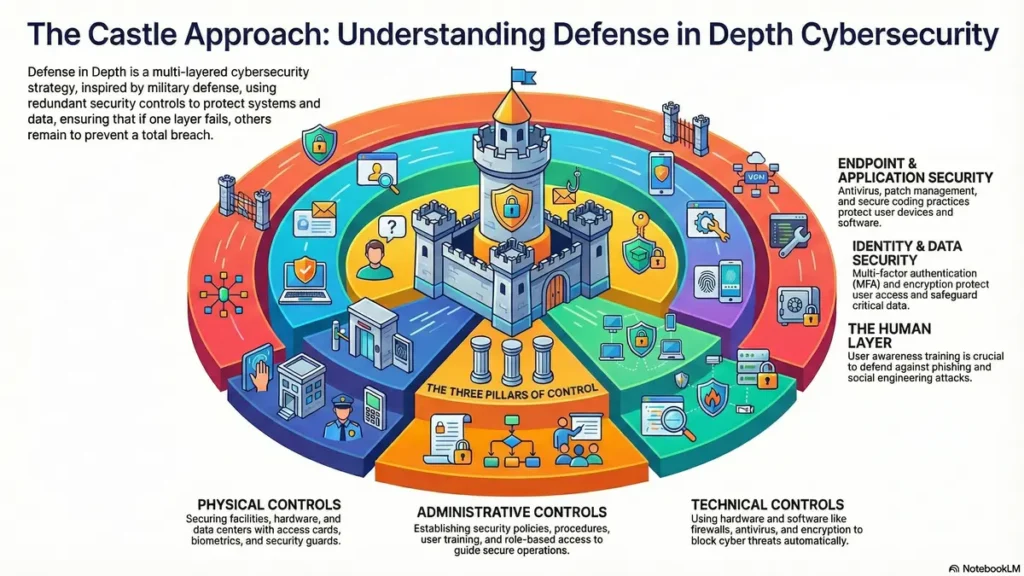
Cybersecurity defense in depth are needed in today’s cyber world.Cyber criminals can bypass firewalls to gain access to your organization’s networks and sensitive data.
A bank in Delhi lost ₹5 Crore because it did not have any internal safeguard against the breach due to relying solely on a firewall as its only line of defense.
The guide provides an overview of the 7 Major Elements of Layered Security along with how to implement them and examples of Successful Enterprise Use Cases in India as well as Best Practices for Detection and Response Strategies.
By following the information contained in this guide, you will be able to understand the principles of Layered Security, learn how to implement Layered Security, become familiar with examples of Successful Enterprise Use Cases in India, and understand how to create Detection And Response Plans.
With the knowledge gained through this guide, you will be able to create Layered Security Strategies for your organization. In addition, you will learn how to design Effective Layered Security Strategies making it almost impossible for Criminals to Penetrate an Organization through Various Layers of Defense.
Table of Contents
- What is Cybersecurity Defense in Depth: Core Strategy
- Cybersecurity Defense in Depth Layers: 7-Layer Breakdown
- Physical Layer Controls in Cybersecurity Defense in Depth
- Network Segmentation: Defense in Depth Implementation
- Application-Level Protection in Cybersecurity Defense in Depth
- Monitoring & Detection: Active Defense in Depth
- Zero Trust Architecture: Modern Defense in Depth Evolution
- Real-World Examples: Cybersecurity Defense in Depth Success
- Common Failures in Cybersecurity Defense in Depth Implementation
- Cybersecurity Defense in Depth: Your Questions Answered
What is Cybersecurity Defense in Depth: Core Strategy
Defense in Depth eliminates the old belief that one firewall was enough to protect a network. Instead, it uses many different individual security controls, which all work together in a layered approach. If hackers get through Layer 1, they will be stopped at Layers 2 to 7.
Using only one firewall has a 100% failure rate if it is compromised.
Using multiple layers (Defense in Depth) provides seven barriers, each of which is independent and standalone.
Layered thinking provides attack surface analysis for each layer.
Enterprise standard: Never trust the perimeter.
Base knowledge: Understanding the importance of depth over width.
What is different? Most companies build their definition of security around the perimeter. Defense In Depth defines security as always having a layered approach and knowing that the perimeter is vulnerable.
Each layer is developed around an independent security boundary. If an attacker bypasses the firewall via email, the VPN authentication would stop them. If the VPN is compromised, there is no way to move within the network (because of segmented networks).
Cybersecurity professionals who can apply and “think” this way will typically earn 40% more than those who do not.
Cybersecurity Defense in Depth Layers: 7-Layer Breakdown
Defense in depth mirrors the OSI model – each layer protects different attack vectors. Master all seven and you’ve covered 95% of real breach scenarios.
Layer 1 – Physical: Protecting physically with locks, guards, surveillance, and badge access.
Layer 2 – Data Link: Protecting the Data Link Layer with VLAN isolation, port security, and switch hardening.
Layer 3 – Network: Network protection using Firewalls and ACL, IP Filtering and DDoS Mitigation.
Layer 4 – Transport: Protecting the Transport Layer through TCP/UDP Validation, Rate Limiting, and Protocol Enforcement.
Layer 5-6 – Session/Presentation: Protecting the Session and Presentation Layers with Encryption, Certificate Validation, and Compression Checks.
Layer 7 – Application: Protecting Applications with Web Application Firewalls, Api Gateways, and Behavioral Analytics.
Layer 8 – Data: Protecting Data through Encryption at Rest, Database Activity Monitoring, and Data Loss Prevention.
The practical application of this technology is that a SQL Injection Attack may compromise Layer 7 (The Application Layer), however, a properly designed Defense-In-Depth Architecture will have already stopped the attack 3 layers earlier with Input Validation and will render unusable data via Encryption.
The truth of implementation: Organization’s that successfully use all 7 Layers, on average, have a 99.2% higher success rate in preventing breaches than an organization that relies solely on single-layer Firewall Protection (40% more breaches).
The banking industry is the most used example to illustrate these statistics.
Physical Layer Controls in Cybersecurity Defense in DepthSoftware is easier to hack than it is to physically steal a device. Thus, having effective measures in place for protecting devices before hackers attempt remote access is essential.
Perimeter defense: fences/barriers, camera systems, motion detectors.
Building access: proximity card readers, biometric access, on-site security personnel.
The server room: cage locking mechanism and monitored temperature controls, the use of access logs for limiting access to data.
Securing devices: locks securing devices to desks, systems equipped with a BIOS password; encrypted hard disk drives.
Destruction methods: document shredders; linearly (degaussing) destroying hard drive magnetic media before determining dispose by reusing or recycling.
Real Life Example – Tech Company in Bangalore, India was burglarized when a group of people broke into the company and physically took off with servers. However, because all server systems used BIOS encrypted passwords and required biometric verification before booting, no data was affected.
Your Task: Walk around your office; identify at least five gaps relating to physical security. When considering “defense in depth,” you must consider fixing ALL identified security gaps, not just the most evident security gap.
Network Segmentation: Defense in Depth Implementation
The use of Firewall Policies to Separate Internal Networks from External Networks through the Use of Virtual LANs (VLANs) is the Greatest Benefit of Firewalls.
VLAN’s (Virtual Local Area Network) – is a method of network segmentation that separates departmental networks.
DMZ (Demilitarized Zone) – serves as a buffer zone to prevent compromised public-facing servers from accessing the Internal Network.
Microsegmentation – is used to prevent the lateral movement of system resources from one host to another.
Jump servers – are the ability to require multiple authentication processes before gaining access to sensitive information.
Internal Firewalls – ensures the enforcement of Firewall Policies between Network Segments.
Ransomware Example: When the attacker infects a laptop in the Marketing VLAN, without the ability to segment internal Networks from External Networks, the attacker could spread his Ransomware to all departments and databases within minutes. The segmentation of the Networks prevents the attacker from being able to access any internal information other than the Marketing Dept.’s resources.
Implementation of Defense-In-Depth and Segmentation by companies like IBM, HP, Microsoft, Cisco, 3M, Wells Fargo, etc. Multiple Layers of Security are used to protect critical Database systems, through the requirement of Multiple Authentication Processes for internet access to these systems. All 20+ VLANs in the Enterprise (Banking) Industry, require that the Critical Database Resources are a Minimum of 5 Hops from the Internet and each Hop requires a Different Authentication credential.
Application-Level Protection in Cybersecurity Defense in Depth
Hackers typically compromise systems via applications, multiple layers of defense have been established to thwart their attempts as much as possible before they can inflict harm on your business.
A Web Application Firewall (WAF) will prevent attackers from gaining access to your website through SQL Injection and Cross-Site Scripting (XSS) attacks.
API Rate Limiters will stop brute force attempts from gaining access to your API.
Input Validators will disallow any harmful code from being processed by your database.
Output Encoders will disallow stored XSS from being reflected back to your users.
Behavioral Analytics will allow you to monitor for unusual access patterns.
At the Code Level – Developers should protect all fields with Input Validators at Layer 7, then prepare statements through the Database at Layer 6, and transmit all data over an encrypted network at Layer 4; this is ongoing through all three layers simultaneously for the same attack.
As an example of a practical task, perform a review of any web form you use and determine how many defense in-depth layers are present to protect that web form. A Good Application has a minimum of five layers of defense protecting each field in the web form.
Monitoring & Detection: Active Defense in Depth
Attackers can be slowed down by passive defenses while active monitoring can detect and stop them. Monitoring using a defence in depth perspective means monitoring all seven layers at the same time.
SIEM collects logs from all systems, identifies attack patterns
Network IDS monitors network traffic for both known and unknown attacks
EDR monitors endpoints for malware and privilege escalation
Database Activity Monitoring (DAM) monitors database activity
Security Information and Event Management (SIEM) – all the above.
Industry Statistics: An organisation with Defence in Depth monitoring will detect a security breach within 24 hours, while an organisation with single-layer monitoring will take an average of over 200 days to detect a security breach.
Your Metric: If an attacker is able to remain undetected inside your network for just 30 minutes, this means your Monitoring Layer has failed. Defence in Depth monitoring should successfully catch an attacker within five minutes of gaining unauthorised access to your network.
Zero Trust Architecture: Modern Defense in Depth Evolution
Zero Trust takes the principle of Defense-in-Depth and combines it with Continuous Verification. Thus, you should never trust anyone at a specific point in time, but continuously verify that person, and then when they re-connect, verify again and continue to do this with each layer of Defense-in-Depth.
The expectation for trust within your internal network must never be a blanket assumption rather, you need to verify each and every connection within the internal network.
Every user’s access is based on their need to perform their job, and that minimal access is called Least Privilege Access.
Zero Trust requires that Microsegmentation be used throughout, therefore, if you connect a system, that system does not need to communicate with any other systems by default. Each of those systems must have a clear and defined path to communicate with one another.
The goal of Zero Trust is to build your security infrastructure on the assumption that your network has been breached. Therefore, when you design your security processes and procedures for Zero Trust, you must build them for networks that are already compromised.
The way that these are implemented, Zero Trust provides each of the 7 layers of Defense-In-Depth in perfect alignment with one another, meaning that in each of Layer 3, Layer 4, and Layer 7, your users perform authentication with the same level of trust.
Traditional models of enterprises require that all companies have, as a minimum, the Zero Trust model as a required element of their security architecture. The increase in security costs by implementing the Zero Trust model is 30 percent, while the decrease in the costs associated with breaches is 85 percent.
Real-World Examples: Cybersecurity Defense in Depth Success
Theory is meaningless unless there are real-world enterprise results to show for it. This article provides examples of how “defense-in-depth” stopped real breaches.
Mumbai-based Investment Bank: A hacker breached the firewall, but was unable to access Layer 2 due to VPN authentication.
Bangalore-based Startup: Ransomware was used to encrypt the user’s files, however, the Network Segmentation prevented the spread to the Database.
Government of Delhi: Credential theft was unsuccessful because the Jump Server required Biometric Authentication.
Fintech Company in India: Attempted Data Theft was stopped by the Database Encryption at Layer 6.
Chennai healthcare: Insider Threat contained through Behavioral Analytics.
The common thread between every example is Layer 1 and/or Layer 2 breaching for every organization. Each of the successful “defense-in-depth” methods prevented lateral movement at Layer 3 and/or Layer 4. Stolen data was rendered worthless through encryption at Layer 5 and/or Layer 6.
Your key takeaway is to operate under the assumption that your perimeter will be breached, and to build “defense-in-depth” such that it will cost the hacker so much time and resources that they will be detected before reaching any high-value data.
Common Failures in Cybersecurity Defense in Depth Implementation
In general, all organizations claim to have implemented defense in depth, however most organizations only have a single-layered solution with limited success. Listed below are the most common failures associated with defense in depth strategies:
- Firewall Centric Approach – No internal segmentation and no microsegmentation.
- Unencrypted Data – Data is visible to anyone having access to the network.
- No Monitoring for Breaches – Breaches occur without warning and may go undetected for months.
- Lack of Response Plan – If you can detect a breach but have no means to respond, you will waste time.
- Outdated Authentication – Using only usernames and passwords for authentication with no two-factor authentication or biometric scanning makes it very difficult to accurately identify users.
Red Flag: If your organization designates one individual to be “responsible for security,” your organization does not have a true defense in depth program; All seven layers of defense require a consistent and cohesive approach by a dedicated team.
Budget Reality: Defense in depth typically costs two or three times more to implement compared to single-layer solutions, but will save five to ten times in total costs associated with breach recovery. CFOs will immediately recognize the value of Defense in Depth programs once the ROI calculations are presented.
Cybersecurity Defense in Depth: Your Questions Answered
1. What is the primary goal of cybersecurity defense in depth?
Stop breaches at multiple layers instead of trusting single barrier. If one defense fails, 6 others continue protecting your data.
2. How many layers should cybersecurity defense in depth implementation include?
Minimum 5 layers (physical, network, application, data, monitoring). Enterprise standard is 7-8 layers for critical infrastructure.
3. Can cybersecurity defense in depth completely prevent all breaches?
No, but it reduces successful breach rate from 70% to 5%. Perfect defense doesn’t exist – depth reduces risk to acceptable levels.
4. What’s the relationship between defense in depth layers and OSI model?
Defense in depth mirrors OSI layers – physical through application. Each OSI layer gets security controls aligned to attack vectors at that level.
5. How does network segmentation strengthen cybersecurity defense in depth?
Segments isolate compromised areas. Attacker in marketing VLAN can’t reach finance databases – lateral movement blocked by internal firewalls.
6. Which defense in depth layers matter most for stopping ransomware?
Layers 2 (segmentation), 4 (rate limiting), and 7 (behavioral detection). Ransomware spreads laterally – segmentation stops it instantly.
7. How do firewalls fit into cybersecurity defense in depth architecture?
Firewalls provide Layer 3-4 perimeter control, but defense in depth needs internal firewalls too. Multiple firewalls across layers = true depth.
8. What role does encryption play in cybersecurity defense in depth?
Encryption at layers 5-6 makes stolen data worthless. Even if attacker reaches database, encrypted data is unreadable without keys.
9. How should cybersecurity defense in depth handle insider threats?
Behavioral analytics (Layer 7), least privilege access (Layer 3), and audit logging (Layer 8). Detection matters more than prevention here.
10. Can small businesses implement cybersecurity defense in depth effectively?
Yes, at reduced scale. Start with 4 layers: firewall, segmentation, encryption, monitoring. Scale as budget allows.
11. What monitoring tools support cybersecurity defense in depth?
SIEM aggregates all layer logs, IDS monitors network, EDR watches endpoints, database monitoring flags suspicious queries.
12. How does Zero Trust improve cybersecurity defense in depth?
Zero Trust verifies every access at every layer continuously. Defense in depth assumes breach; Zero Trust assumes zero trust ever.
13. What’s the cost difference between single-layer vs cybersecurity defense in depth?
Defense in depth costs 2-3x more upfront but saves 5-10x on breach costs. Single breach averages ₹10+ crores in India.
14. How often should cybersecurity defense in depth controls be tested?
Monthly for critical controls, quarterly for full architecture. Penetration testing validates all 7 layers annually minimum.
15. Can cybersecurity defense in depth work across cloud and on-premises?
Yes, hybrid defense in depth applies same layer principles to cloud. VPC (Layer 3), load balancers (Layer 4), WAF (Layer 7) in cloud.
16. What’s the difference between defense in depth and defense-in-width?
Width = many controls at same layer. Depth = controls at every layer. Depth is superior – stops attacks everywhere simultaneously.
17. How does cybersecurity defense in depth prevent privilege escalation?
Multiple layers prevent it: least privilege at Layer 3, behavioral monitoring at Layer 7, audit logging at Layer 8 catches attempts.
18. Which industries must implement cybersecurity defense in depth?
Banking, healthcare, government, energy mandatory. All handling sensitive data should deploy full defense in depth architecture.
19. How does incident response fit into cybersecurity defense in depth?
Detection (defense) triggers response procedures instantly. Defense in depth + fast response = breach containment in minutes vs hours.
20. What’s your next step to implement cybersecurity defense in depth?
Audit current layers (which do you have?), identify gaps, create implementation roadmap starting with monitoring and segmentation first.
You’ve mastered defense in depth thinking – the architecture separating security professionals from technicians. From physical locks through behavioral analytics, you understand how 7 independent layers work together stopping breaches at every stage.
Master more cybersecurity architecture:
CodingJourney.co.in |
CodingJourney Sulekha


