
You are sitting around. Your phone starts buzzing. You feel a little scared or really excited. It is a message from Your Bank saying your account is blocked.. It is a message saying you won the Lottery Win for a contest you do not remember entering. They want you to click on something away.
In this article you will find out how these phishing scams on whatsapp work. You will learn how to spot links and check if the person sending you a message is really who they say they are, like Your Bank or someone else. You will get really good at figuring out if something is a scam or not.
By the end of this guide, you will gain the confidence to protect your personal data, secure your financial accounts, and teach your family how to navigate the app without falling victim to fraud. This new understanding will transform you from a potential target into a savvy digital defender who can spot a scam from a mile away.
Table of Contents
- What is a phishing scam on whatsapp and how it works
- Common types of phishing scam on whatsapp attacks
- Social engineering tactics in a phishing scam on whatsapp
- How to identify a phishing scam on whatsapp instantly
- Financial and personal risks of a phishing scam on whatsapp
- Step-by-step protection from a phishing scam on whatsapp
- Protecting family from a phishing scam on whatsapp
- Reporting a phishing scam on whatsapp to authorities
- Emerging trends in phishing scam on whatsapp technology
What is a phishing scam on whatsapp and how it works
To stop a phishing scam on whatsapp you need to know
People who try to scam others know that we really trust the messaging apps we use. So they use these apps to send things right to our phones. We think of WhatsApp as an private place to talk to our friends and family. That is why we are more likely to click on links we get on WhatsApp than, on links we get in emails.
The bad people make a page that looks just like the page of your bank or a social media site, like Facebook. When you put in your information the bad people get it away and use it to take control of your bank accounts or your social media accounts.
Common types of phishing scam on whatsapp attacks
- Fake “KYC Update” requests from popular banks
- “You Won a Prize” messages from famous brands
- Part-time job offers with unrealistically high salaries
- Electricity bill payment reminders with threat of disconnection
- Fake WhatsApp Web QR codes designed to mirror your account
- OTP verification requests from “bank officials”
- Delivery package delay notifications requiring payment
- Passport/Visa renewal urgent alerts
- Income Tax refund confirmation links
- COVID vaccine certificate update requests
- Free Amazon/Flipkart gift card offers
- IRCTC ticket booking confirmation scams
- Aadhaar linking mandatory warnings
- Mutual fund investment opportunity messages
- Police verification call recording requests
- WhatsApp premium subscription upgrade offers
- EPF withdrawal verification links
- Land registry/document verification urgency
- Charity donation requests during festivals
In India people need to be careful about KYC scams. These KYC scams are very bad because they tell people that their bank accounts or SIM cards will be closed. This makes people very worried. They can make mistakes easily because of this worry, about their bank accounts and SIM cards.
People looking for a job or some extra money are often targeted by scam artists. These scam artists ask for a bit of money to process the job application or they want your bank information. They make their emails and websites look very professional, with logos and formal words so that they appear to be real companies. They use job offer scams to trick students and professionals who are looking for income.
Lottery and prize scams play on the emotion of greed, making the victim believe they have been exceptionally lucky. Once the victim is hooked, they are asked to pay “taxes” or “transfer fees” to claim the non-existent prize.
Social engineering tactics in a phishing scam on whatsapp
- Creating a false sense of extreme urgency
- Exploiting fear of loss or legal consequences
- Using “Authority” by pretending to be police or bank officials
- Leveraging “Reciprocity” by offering a small gift first
- Building fake rapport through friendly conversation
How to identify a phishing scam on whatsapp instantly
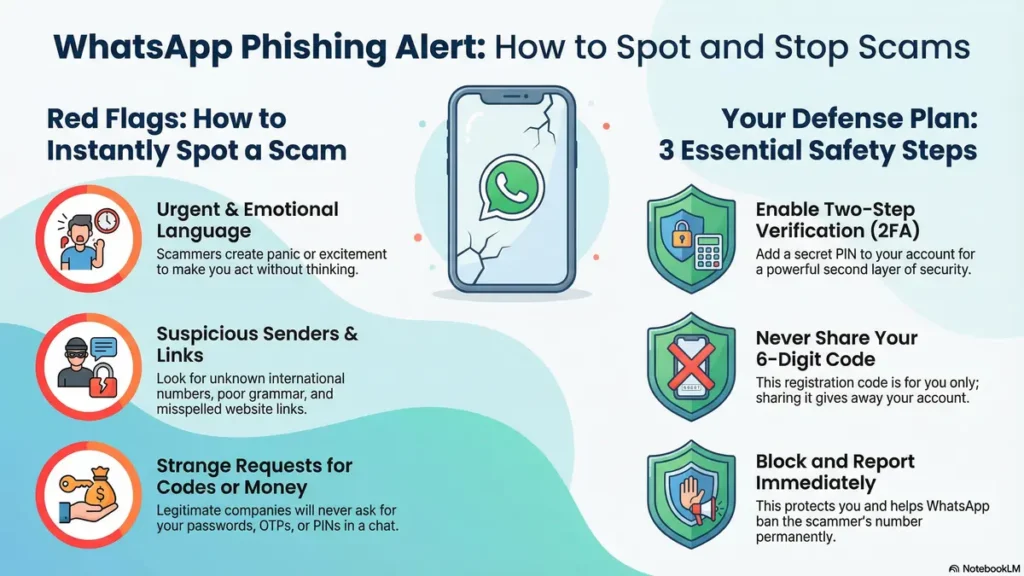
You can figure out if something is a scam, on WhatsApp quickly if you know what to look for. The best way to protect yourself from these scams the really sneaky ones is to learn what things do not look right and watch out for them when you are using WhatsApp. You need to teach yourself to notice these things that’re not quite right.
- Suspicious or misspelled URLs (e.g., amozon.co instead of amazon.com)
- Messages from unknown international country codes
- Poor grammar, spelling mistakes, and strange formatting
- Highly emotional or threatening language
- Lack of official verification badges on business accounts
Financial and personal risks of a phishing scam on whatsapp
If you get caught up in a phishing scam on WhatsApp it can cause a lot of problems. Losing access to WhatsApp is the start. The problems that come from this can affect your money. What people think of you for a very long time. The phishing scam, on WhatsApp can really hurt your situation and your personal reputation for years to come.
- Unauthorized withdrawals from linked bank accounts
- Identity theft leading to fraudulent loan applications
- Loss of sensitive personal photos and private chats
- Blackmail or extortion attempts using stolen data
- Damage to your credit score due to financial fraud
Step-by-step protection from a phishing scam on whatsapp
To be safe from phishing scams, on WhatsApp you need to take steps to prevent them. If you follow the rules to keep your account secure it will be very hard for scammers to get to you. This way your WhatsApp account will be a target that most phishing scammers will not want to bother with because they like easy targets. So active prevention is the way to protect your digital life from phishing scams on WhatsApp.
- Enable Two-Step Verification (2FA) in WhatsApp settings immediately
- Set your profile photo and ‘last seen’ to ‘Contacts Only’
- Use a dedicated security app to scan for malicious links
Do not give your 6-digit registration code to anyone it is private and only for you to know. Always keep your 6-digit registration code safe and secure do not share it with anyone all.
When you get a message, from a number that seems suspicious you should block that number. Report it right away.
Protecting family from a phishing scam on whatsapp
- Conduct a mini-security audit on your parents’ phones
- Set up Two-Step Verification for all family members
- Create a “Family Password” for verifying urgent money requests
Tell the people in your group to be careful and never click on links that say “Free Gift” because they can be bad for your computer and your information.
Make sure they know that “Free Gift” links in groups are usually not what they seem to be and can cause problems.
Remind them to stay safe by avoiding “Free Gift” links in groups, at all times.
First you need to teach people how to block numbers that they do not know.
Then you have to show them how to report these numbers so they do not get annoying calls or messages from unknown numbers anymore.
You have to explain to them that blocking and reporting numbers is very important for their safety and security.
This way they can avoid getting calls, from numbers and they can report unknown numbers easily.
Older adults are often targeted by Bank or Government scams because they tend to be more respectful of authority figures.
Kids might fall for scams that say “Free Game Currency” or “Celebrity Chat”. You should keep an eye on the groups they join and make sure their privacy settings are really strong.
Encourage an open environment where family members feel comfortable asking, “Is this message real?” before they act. A quick five-minute conversation can save thousands of dollars in losses.
Reporting a phishing scam on whatsapp to authorities
When you report a phishing scam on WhatsApp you are doing a favor to the whole WhatsApp community. This helps to shut down the people who are doing these scams. It is our responsibility to report these things because it makes the internet a safer place for everyone to use. Reporting phishing scams on WhatsApp is something we should all do because it helps to stop the guys and make WhatsApp safer, for the WhatsApp community.
- Use the built-in “Report” button inside the WhatsApp chat
- Take screenshots of the chat and the scammer’s phone number
- File a complaint on the National Cyber Crime Reporting Portal (India)
- Report the malicious URL to Google Safe Browsing and PhishTank
If you think someone has gotten your information you need to tell your bank right away. Your bank needs to know if your financial data was shared with someone.
In India if you are a victim of cybercrimes you can call 1930. This is the helpline for financial cybercrimes. It is very important to report cybercrimes quickly. You should do it within the Golden Hour. If you report cybercrimes within the Golden Hour it increases the chances of freezing the stolen money in the scammers account. This means you might be able to get your money if you act fast and call 1930 the dedicated helpline, for financial cybercrimes.
Don’t just delete the message; reporting it ensures that the technical signatures of the scam are logged. This helps security researchers develop better filters to block similar messages in the future.
Emerging trends in phishing scam on whatsapp technology
The way people try to trick others on Whatsapp is changing. Now they are using computers to do it. We need to be careful and stay one step ahead of these tricks. This way we will not be caught off guard when new types of scams come out. The phishing scam on Whatsapp is getting more advanced and using intelligence. So we need to be aware of the phishing scam, on Whatsapp and how it’s changing.
- Chatbots that can have conversations with people and sound very real like the chatbots are really good, at talking to people and the chatbots can keep the conversation going for a long time
- Deepfake images used in fake video calls to verify identity
- Use of cryptocurrency for untraceable “tax” payments in scams
You can have voice notes that are made by a computer to sound like your family members. These voice notes are made by intelligence, which is, like a computer program that can do things that people can do like talk and sound like someone you know like your family members.
There is a type of software called malware that does something really bad. This malware will automatically send links to all of your contacts. These fake links are usually scams. The malware sends these scam links to everyone, in your contact list.
People can make a copy of someones voice using a computer in a few seconds. This means that scam artists can make emergency phone calls that sound really real. The fake emergency phone call scam is now a lot more believable and a lot more scary because of this voice copying technology. This technology is called AI voice cloning. It is very good, at making fake voices that sound like real people.
We are seeing more scams that have to do with Liquidity Mining and Crypto Investment, on WhatsApp. These scams are really bad because they go on for a time. The person who is scamming will talk to you for weeks. Try to make you trust them. After that they will ask you to put money into something.
The use of “disappearing messages” by scammers is also on the rise to hide evidence of their crime. Always take screenshots immediately if you suspect you are talking to a fraudster.
Frequently Asked Questions
What is a phishing scam on whatsapp?
A phishing scam on whatsapp is a fraudulent attempt by cybercriminals to steal your personal information or money by sending deceptive messages. They often pretend to be banks, friends, or famous brands to trick you into clicking malicious links.
How can I spot a phishing scam on whatsapp?
You can spot a phishing scam on whatsapp by looking for red flags like unknown international numbers, urgent threats, poor grammar, and suspicious links. If the message asks for money or an OTP, it is almost certainly a scam.
Can I get hacked by just opening a message?
Simply opening a text message in a phishing scam on whatsapp is generally safe. However, clicking on links, downloading files, or sharing your verification codes within that message is what leads to your account being compromised.
What should I do if I click a link in a phishing scam on whatsapp?
If you click a link in a phishing scam on whatsapp, immediately disconnect your internet and scan your phone for malware. Change your bank passwords and enable two-factor authentication on all your important accounts right away.
Is the “WhatsApp Gold” message a phishing scam on whatsapp?
Yes, “WhatsApp Gold” is a classic phishing scam on whatsapp that has existed for years. It promises “exclusive” features but actually installs malware on your device to steal your private information and monitor your activity.
Why do I keep getting phishing scam on whatsapp messages?
You receive phishing scam on whatsapp messages because your phone number was likely part of a data breach or was scraped from social media. Scammers buy lists of active numbers to send bulk fraudulent messages.
How do scammers get my number for a phishing scam on whatsapp?
Scammers get your number for a phishing scam on whatsapp through public social media profiles, malicious apps, or by purchasing databases from the dark web. Sometimes, they simply use software to generate and message random numbers.
Can blocked numbers still send a phishing scam on whatsapp?
No, once you block a number, they cannot send you any more phishing scam on whatsapp messages. However, scammers often use hundreds of different numbers, so you may receive similar messages from new accounts.
Should I reply to a phishing scam on whatsapp to tell them I know?
Never reply to a phishing scam on whatsapp. Replying confirms that your number is active and that a real human is reading the messages, which will only lead to you receiving even more scam attempts.
Can a phishing scam on whatsapp steal my bank details?
Yes, a phishing scam on whatsapp can steal bank details if you click a link and enter your info on a fake website. Some scams also use malware to record your screen while you type in your banking app.
What is the “Hi Mum” phishing scam on whatsapp?
The “Hi Mum” phishing scam on whatsapp is an emotional fraud where a scammer pretends to be your child who has lost their phone. They ask for an urgent money transfer to pay a “bill” or buy a new device.
Does WhatsApp ever message users directly?
WhatsApp rarely messages users. If they do, the chat will have a green verified badge and a specific “Official WhatsApp” label. Any other message claiming to be from “WhatsApp Support” is a phishing scam on whatsapp.
Can 2FA prevent a phishing scam on whatsapp?
Two-Step Verification (2FA) is highly effective against a phishing scam on whatsapp. Even if a scammer steals your OTP, they still cannot log into your account without your secret 6-digit PIN.
How do I report a phishing scam on whatsapp in India?
In India, you should report a phishing scam on whatsapp on the official website www.cybercrime.gov.in. You can also call the national cybercrime helpline at 1930 for immediate assistance with financial frauds.
Are “Job Offer” messages a phishing scam on whatsapp?
Most unsolicited job offers on the app are a phishing scam on whatsapp. They usually offer high pay for simple tasks but eventually ask you to pay a “registration fee” or share your bank details.
What is the QR code phishing scam on whatsapp?
The QR code phishing scam on whatsapp involves a scammer sending you a QR code and asking you to scan it to “receive money.” In reality, scanning it gives the attacker full access to your WhatsApp account on their computer.
Can scammers see my chats through a phishing scam on whatsapp?
Scammers cannot see your encrypted chats directly through a phishing scam on whatsapp unless they successfully hijack your entire account or install spyware on your device. This is why account security is so critical.
What is the risk of “Free Gift” links in a phishing scam on whatsapp?
“Free Gift” links in a phishing scam on whatsapp are usually designed to steal your personal data. They often redirect you through multiple ad-sites that install tracking cookies or malware on your mobile browser.
How can I protect my parents from a phishing scam on whatsapp?
Protect your parents from a phishing scam on whatsapp by enabling 2FA on their phones and teaching them to never click on links from unknown numbers. Regularly check their “Linked Devices” for any suspicious activity.
What is the “Rediroff.ru” phishing scam on whatsapp?
The “Rediroff.ru” phishing scam on whatsapp is a viral fraud that promises rewards for filling out surveys. It leads users through a chain of malicious websites to steal personal data and financial information.
Conclusion
Mastering the art of detecting a phishing scam on whatsapp is an essential life skill in our hyper-connected world. We have covered everything from the psychological tactics of social engineering to the technical steps of enabling two-step verification and reporting crimes to the authorities. You are now equipped with the knowledge to identify suspicious links, verify official business accounts, and maintain a secure digital perimeter around your personal information.
With this information, you can confidently navigate your chats without the fear of falling for sophisticated traps. However, cyber threats are constantly evolving, and staying informed is a continuous journey. To further strengthen your digital defenses, we encourage you to explore our related guides on cybersecurity basics, the psychology of social engineering, and best practices for safe digital banking. Protecting yourself is the first step, but sharing this knowledge with your community is how we truly stop these fraudsters in their tracks. Read our other safety guides to stay one step ahead of the criminals.
Coding Journey – Learn Coding & Cybersecurity
Coding Journey on Sulekha – Tech Training & Services


