
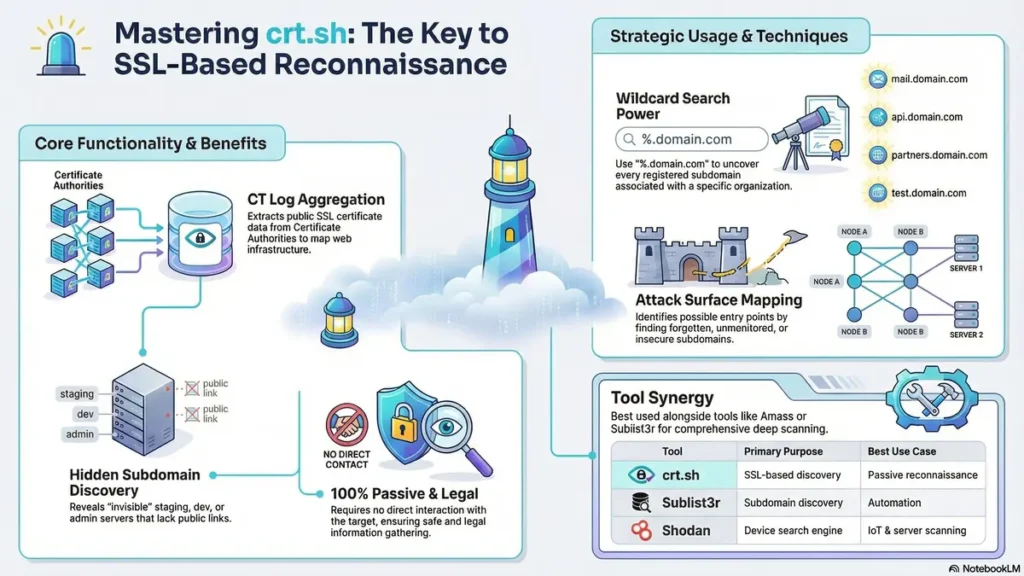
If you are learning Ethical Hacking, Cybersecurity, or Reconnaissance, you might have heard about crt.sh. It is one of the most powerful and free tools used by hackers and cybersecurity experts.
In this guide, you will learn:
What is crt.sh?
How does it work?
How to use this tool for reconnaissance?
Use cases?
Benefits and drawbacks?
Let’s learn step by step.
What is crt.sh?
crt.sh is a free online tool that helps you find subdomains and SSL/TLS certificates for any website.
It uses a publicly available database called Certificate Transparency (CT logs) to collect SSL/TLS certificate details.
👉 In simple words:
A website receives an SSL certificate (HTTPS), and its details are publicly available. crt.sh will show you those details.
Why crt.sh is Important in Cybersecurity
crt.sh is used for reconnaissance, which is the first step in ethical hacking.
Key Uses:
Find hidden subdomains
Find internal servers
Attack surface mapping
Bug bounty hunting
OSINT (Open Source Intelligence)
How crt.sh Works
When a website wants to enable SSL/HTTPS, it needs to get a certificate from a Certificate Authority.
The certificate will be added to public CT logs.
crt.sh uses this data.
Example:
If you search:
%.example.com
The result will be:
mail.codingjourney.co.in
dev.codingjourney.co.in
api.codingjourney.co.in
staging.codingjourney.co.in
These are subdomains that may not be publicly available.
Advanced Search Techniques
To get better results, you can use these tricks:
1. Wildcard Search
%.codingjourney.co.in2. Exact Match
codingjourney.co.in
3. Filter by Organization
Search for “company name” instead of “domain.”
Real-Life Use
Suppose you are doing a bug bounty program.
You can perform a search for:
%.company.com
Possible results may be:
dev.company.com
test.company.com
admin.company.com
These are often:
Less secure
Not monitored properly
👉 Hackers test these for vulnerabilities.
Advantages of Using crt.sh
1. Free Tool
No need to login or pay.
2. Easy to Use
Beginners can use this tool.
3. Powerful Data Source
Uses actual SSL certificate logs.
4. Passive Recon Tool
No direct interaction with target → safe and legal.
Limitations
1. Not Real-Time Always
Some data may be old.
2. Too Much Data
Large domains have thousands of results.
3. No Filtering Options
Manual filtering needed.
4. Misses Non-SSL Domains
Only shows domains that have SSL certificates.
crt.sh vs Other Recon Tools
| Tools | Purpose | Best Use |
|---|---|---|
| crt.sh | SSL-based subdomain discovery | Passive recon |
| Sublist3r | Subdomain discovery | Automation |
| Amass | Advanced recon | Deep scanning |
| Shodan | Device search engine | IoT & server scanning |
Tips to Use Like a Pro
Always use wildcard %
Use in conjunction with other tools like Amass
Look for weird subdomains
Verify recent issued certificates
Use in vulnerability scanning
Is crt.sh Legal?
Yes, This tool is completely legal.
Why?
It uses public data.
No hacking involved.
No direct interaction with the target.
👉 It is widely used in ethical hacking.
Who Should Use crt.sh?
This tool can be used by:
Students who want to learn cybersecurity.
Ethical hackers.
Bug bounty hunters.
Security analysts.
Developers.
Conclusion
This is a great and simple tool for subdomain enumeration using SSL certificate information. This is a vital tool in the field of ethical hacking and cybersecurity.
So, if you are new to the field of cybersecurity, then this tool should be in your toolkit.
👉 This tool should be used in combination with other tools to master the art of reconnaissance.
FAQs
1. What is the use of crt.sh?
The use of this tool is to fetch the subdomains and the SSL certificate of the website.
2. Is crt.sh free to use?
Yes, it is absolutely free to use.
3. Is crt.sh suitable for beginners?
Yes, it is very easy and suitable for beginners.
4. Is crt.sh safe and legal to use?
Yes, it is safe and legal to use.
5. Does crt.sh show all the subdomains of the website?
No, it will show the domains with the SSL certificate.
6. How do I find hidden domains of a website?
SSL certificate information is used to find hidden domains of a website.
7. What is the role of SSL/TLS in reconnaissance?
SSL/TLS certificates contain useful information that can be used in gathering information.
8. Can beginners easily conduct subdomain discovery?
Yes, subdomain discovery can be done by beginners using easy tools and logs.
9. What is OSINT in cybersecurity?
OSINT stands for Open Source Intelligence. It refers to the collection of publicly available information.
10. What is the importance of internal subdomains in cybersecurity?
Internal subdomains have weak security and can be used as entry points for vulnerabilities.
11. How do bug bounty hunters collect hidden information?
Bug bounty hunters collect publicly available information using certificate logs, DNS logs, and search engines.
12. What is the main difference between active and passive information gathering?
The main difference between active and passive is that active involves direct interaction with the target, while passive uses publicly available information.
13. Can SSL logs be used to reveal sensitive information?
SSL logs can be used to reveal domain names but cannot be used to reveal sensitive information.
14. What are some common subdomain names that are often found in reconnaissance?
The common subdomain names that are often found in reconnaissance include dev, test, staging, admin, mail, and api.
15. How often are certificate logs updated?
The certificate logs are updated regularly. However, there is a slight delay in updating the logs.
16. What are some of the tools that can be used for subdomain enumeration?
The common tools that can be used for subdomain enumeration include automated tools, DNS tools, and certificate logs search tools.
17. What is the importance of subdomain discovery in cybersecurity?
The importance of subdomain discovery in cybersecurity is that it helps to identify the attack surface of the target.
18. Will SSL-based discovery miss some domains?
Yes, some domains will be missed in SSL-based discovery if they do not have SSL certificates.
19. What is attack surface mapping?
Attack surface mapping is the identification of all the possible entry points of a system.
20. How can I improve my skills in reconnaissance?
You can improve your skills in reconnaissance by practicing using different tools and studying real-life scenarios.
🌟 Stay Connected with Coding Journey 🌟
Friends,
I’ve started Coding Journey to share tech knowledge, cybersecurity awareness, digital marketing tips, and practical tutorials to help everyone grow safely in the digital world.
If you find value in learning about:
✅ Linux & Cybersecurity
✅ Digital Marketing & SEO
✅ Online safety & scam awareness
✅ Practical tech guides
I’d really appreciate your support and follow 🙏
🔗 Official Website & Blog
🌐 https://codingjourney.co.in
📝 https://codingjourney1983.blogspot.com
🔗 Follow on Social Media
🔵 Facebook: https://www.facebook.com/people/Coding-journey/61585197473575/
💼 LinkedIn: https://www.linkedin.com/in/sunil-kumar-tiwari-07b8b466
🐦 X (Twitter): https://x.com/suniltiwari4509
📸 Instagram: https://www.instagram.com/coding9529/
📌 Pinterest: https://in.pinterest.com/codingjourney1983/
❓ Quora: https://www.quora.com/profile/Sunil-4966
✍️ Medium: https://medium.com/@codingjourney1983
Your one follow, like, or share really motivates me to create more helpful content 💙
Thank you for supporting Coding Journey 🙌
Let’s learn, grow, and stay secure together.
Related Posts
 DNSRecon Guide 2026: Find Hidden Subdomain Fast
In today’s digital age, cybersecurity is more important than ever. One of the most powerful…
 Related Google Search Operator: Complete SEO Guide (2026)
If you want to discover your competitors’ websites, find similar blogs, or explore niche-specific websites,…
 SecurityTrails Explained: Powerful OSINT Tool 2026
In today’s digital world, knowing what is available on the internet is one of the…
 What is Knockpy? Beginner Guide (2026)
In the world of cybersecurity and ethical hacking, one of the most important steps in…