
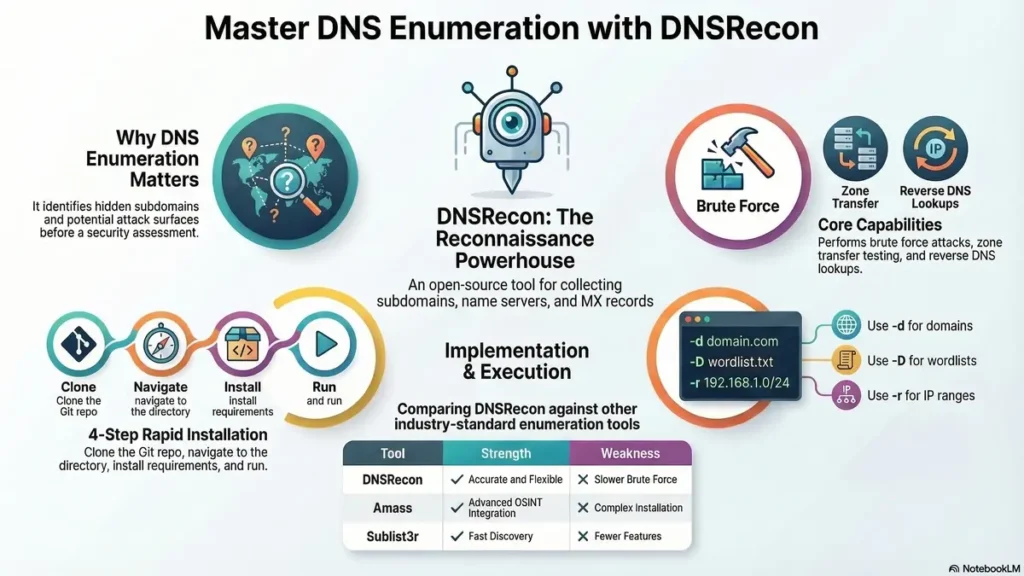
In today’s digital age, cybersecurity is more important than ever. One of the most powerful tools used by ethical hackers and cybersecurity experts is DNS enumeration. Of the top tools used to perform DNS enumeration, DNSRecon stands out as a top tool in this category.
In this DNSRecon guide, we will walk you through what DNSRecon is, how it works, its features, installation, and how to use this subdomain enumeration tool like a pro!
What is DNSRecon?
It is an open-source DNS enumeration tool used to collect information about a domain’s DNS records. It is used by cybersecurity experts to identify possible vulnerabilities in a system by collecting data such as:
Subdomains
Name servers
MX records
Zone transfers
Reverse lookups
It is used in penetration testing, bug hunting, and reconnaissance in ethical hacking.
Why DNS Enumeration is Important
Before any kind of cyber attack or security assessment, it is important to have a good understanding of the target system. DNS enumeration is important for:
Discovery of hidden subdomains
Discovery of network infrastructure
Discovery of misconfigured DNS servers
Discovery of potential attack surfaces
If reconnaissance is not done correctly, even a sophisticated attack can go wrong.
Key Features
It is a tool that is packed with many important features, making it a must-have for any cybersecurity expert. The key features of are as follows:
1. Subdomain Enumeration
This intelligence gathering tool can be used for subdomain discovery through various types of attacks, including brute force and dictionary attacks.
2. Zone Transfer Testing
It can be used to check if a DNS server allows a zone transfer, which can potentially leak information.
3. Reverse DNS Lookup
It can be used for reverse DNS lookup to check for associated domains with an IP address.
4. Brute Force Attack
It can be used for a brute force attack with wordlists to find hidden subdomains.
5. DNS Record Enumeration
Different DNS records can be enumerated, which include:
A records
MX records
NS records
TXT records
6. Integration with Wordlists
Custom wordlists can be integrated for better results.
How This tool Works
It works by sending queries to the DNS server and collecting the responses. It achieves this by using various methods, which include:
Standard DNS queries
Brute force
Zone transfer
Reverse lookups
The collected information is then compiled and organized for easier analysis.
Installation
The installation process of this information gathering tool is easy and can be done on any Linux operating system, such as Kali and Ubuntu.
Step 1: Clone the Repository
git clone https://github.com/darkoperator/dnsrecon.git
Step 2: Navigate to Directory
cd dnsrecon
Step 3: Install Requirements
pip3 install -r requirements.txt
Step 4: Run DNSRecon
python3 dnsrecon.py
Basic Usage
Below are some of the basic commands:
1. Standard Enumeration
python3 dnsrecon.py -d example.com
2. Brute Force Subdomains
python3 dnsrecon.py -d example.com -D wordlist.txt -t brt
3. Zone Transfer
python3 dnsrecon.py –
4. Reverse Lookup
python3 dnsrecon.py -r 192.168.1.0/24
Real-World Use Cases
This information gathering tool has a number of real-world use cases in the field of cybersecurity, including:
Real-World Use Case 1: Penetration Testing
Security experts use this tool for penetration testing by creating a map of a target network before conducting a test of its vulnerabilities.
Real-World Use Case 2: Bug Bounty Hunting
It is also helpful in Bug Bounty Hunting, as it helps in the detection of hidden assets, which may contain security bugs.
Real-World Use Case 3: Red Team
It is also used by Red Teams in the reconnaissance phase of a penetration test.
Real-World Use Case 4: Network Auditing
It is also helpful in detecting misconfigurations in DNS servers by organizations.
Advantages
It is open-source and free, making it easily accessible for security testing.
It is easy to use and has a number of techniques for performing DNS enumeration.
It is highly effective in the reconnaissance phase of a penetration
DNSRecon vs. Other Tools
Let’s compare with other tools:
| Tool | Strengths | Weaknesses |
|---|---|---|
| DNSRecon | Accurate and Flexible | Slightly Slower than Others in Brute Force |
| Amass | Integration with Advanced OSINT Tools | Complicated Installation Process |
| Sublist3r | Fast Subdomain Discovery | Few Features |
| Knockpy | In-Depth Subdomain Discovery | Resource-Consuming |
This tool is suitable for beginners and professionals who want a mix of ease and power.
Best Practices
Here are the best practices:
Use the latest wordlists
Use it in combination with other tools like Amass
Avoid aggressive scanning
Ensure proper authorization
Is DNSRecon Legal?
Yes, It is legal as long as it’s used ethically. You should:
Use it on your own system
Ensure proper authorization before scanning others
Comply with cyber laws
Pro Tips for Getting the Most Out of this tool
Here are some pro tips for getting the most out of this information gathering tool:
Use multiple wordlists
Use it in combination with other tools like Nmap
Use scripts to automate the process
Conclusion
It is a powerful and vital tool for anyone interested in learning more about the world of cybersecurity, ethical hacking, or network exploration. It can help identify critical information pertaining to the target’s DNS infrastructure.
Whether you’re a beginner or a professional, learning DNSRecon can help improve your skills in ethical hacking.
FAQs
1. What is the use of DNSRecon?
DNSRecon is used to perform DNS enumeration, which is used to obtain domain-related information and identify potential security threats.
2. Is DNSRecon free?
Yes, it is completely free and open-source.
3. Can a newbie use DNSRecon?
Yes, but a good knowledge of networking and DNS is required.
4. What is DNS enumeration?
It is the process of obtaining DNS-related information about a target domain.
5. Is DNSRecon more effective than Sublist3r?
Yes, it has more features, but Sublist3r is more efficient in performing tasks.
6. Can DNSRecon be used in Windows?
Yes, it works best in a Linux environment, but it can be used in Windows with the help of Python.
7. What is a zone transfer attack?
It is a technique used to obtain complete DNS records in the case of a misconfigured DNS.
8. Is it safe to use DNSRecon?
Yes, it is completely safe and can be used ethically and with permission.
9. Can it be used to find hidden subdomains?
Yes, especially with the help of brute force.
10. Why is DNS important in cybersecurity?
It is important because it reveals the structure of the network, and it is a crucial aspect in security analysis.
11. What is a DNS lookup in cybersecurity?
A DNS lookup is the process of querying a domain to get its IP address and related records. It helps in identifying network structure and services.
12. How does subdomain discovery help in security testing?
Subdomain discovery reveals hidden assets of a website. These assets may contain vulnerabilities that can be tested during security assessments.
13. What are DNS records and why are they important?
DNS records store information about a domain, like IP addresses and mail servers. They help systems communicate over the internet.
14. What is brute force subdomain scanning?
It is a method of finding subdomains by trying multiple word combinations. This helps uncover hidden or unlisted domains.
15. What is reverse DNS lookup used for?
Reverse DNS lookup is used to find domain names linked to an IP address. It helps in mapping network infrastructure.
16. What is zone transfer in DNS?
Zone transfer is a process where DNS data is copied from one server to another. If misconfigured, it can expose sensitive information.
17. How do wordlists improve domain enumeration?
Wordlists provide a list of possible subdomain names. Using them increases the chances of discovering hidden domains.
18. What tools are used for domain reconnaissance?
Common tools include Amass, Sublist3r, and other sudomain enumeration tools. They help gather domain-related intelligence.
19. What is DNS misconfiguration?
DNS misconfiguration happens when settings are not properly secured. This can lead to data exposure or security risks.
20. Why is reconnaissance important in ethical hacking?
Reconnaissance helps gather information about a target system. It is the first step in identifying vulnerabilities and planning security tests.
If you want next:
✅ FAQs 21–30
✅ Schema markup for all FAQs
✅ Internal linking strategy for ranking 🚀
🌟 Stay Connected with Coding Journey 🌟
Friends,
I’ve started Coding Journey to share tech knowledge, cybersecurity awareness, digital marketing tips, and practical tutorials to help everyone grow safely in the digital world.
If you find value in learning about:
✅ Linux & Cybersecurity
✅ Digital Marketing & SEO
✅ Online safety & scam awareness
✅ Practical tech guides
I’d really appreciate your support and follow 🙏
🔗 Official Website & Blog
🌐 https://codingjourney.co.in
📝 https://codingjourney1983.blogspot.com
🔗 Follow on Social Media
🔵 Facebook: https://www.facebook.com/people/Coding-journey/61585197473575/
💼 LinkedIn: https://www.linkedin.com/in/sunil-kumar-tiwari-07b8b466
🐦 X (Twitter): https://x.com/suniltiwari4509
📸 Instagram: https://www.instagram.com/coding9529/
📌 Pinterest: https://in.pinterest.com/codingjourney1983/
❓ Quora: https://www.quora.com/profile/Sunil-4966
✍️ Medium: https://medium.com/@codingjourney1983
Your one follow, like, or share really motivates me to create more helpful content 💙
Thank you for supporting Coding Journey 🙌
Let’s learn, grow, and stay secure together.
Related Posts
 What is Knockpy? Beginner Guide (2026)
In the world of cybersecurity and ethical hacking, one of the most important steps in…
 Related Google Search Operator: Complete SEO Guide (2026)
If you want to discover your competitors’ websites, find similar blogs, or explore niche-specific websites,…
 Best Subdomain enumeration tool: Bug Bounty Weapon for 2026
Best subdomain enumeration tool is an essential part of every cybersecurity professional’s or ethical hacker’s…
 Findomain: The Fastest Subdomain Enumeration Tool
In the world of cybersecurity and ethical hacking, reconnaissance is the first and the most…