
Ethical hacking practice is exploding now-Millions of attacks hit organizations each and every day, and companies are desperate for people who can think like hackers but protect like defenders! Everything you thought you knew about cybersecurity careers and who gets into this field has now changed.
Are you ready to unlock a practical, safe, step‑by‑step method for practising hacking—even if you’re a total beginner? Dive in, then visit https://codingjourney.co.in and https://codingjourney.sulekha.com for more!
🚀 Table of Contents – Ethical Hacking Practice Power Guide
- 🔥 Introduction: what is ethical hacking
- 1️⃣ Why Ethical Hacking Practice Matters Today
- 2️⃣ How To Practice Ethical Hacking Safely (Legally)
- 3️⃣ Hacker Mindset: Think Like An Attacker, Act Like A Protector
- 4️⃣ Core Skills You Need Before Practicing
- 5️⃣ Best Ethical Hacking Practice Labs & Websites
- 6️⃣ Build Your First Home Hacking Lab (Step‑By‑Step)
- 7️⃣ Beginner‑Friendly Ethical Hacking Tools To Practice
- 8️⃣ 30‑Day Ethical Hacking Practice Plan (Beginner Roadmap)
- 9️⃣ Real‑World Wins: How Practice Turns Into Opportunity
- 🔍 Hidden Dangers Of Practicing Wrong (And How To Avoid Them)
- 💡 Ethical Hacking Practice For Non‑Technical People
- 🚀 From Practice To Career: Next Steps & Certifications
- 🔥 Ethical Hacking Practice FAQ
🔥 Introduction: what is ethical hacking
Ethical hacking simply means using one’s hacking skills with permission to find weaknesses in system before hacker do. Companies call this “offensive security” or “penetration testing,” and it is one of the most in‑demand cybersecurity skills globally.
The biggest issue with beginners is not “learning hacking,” but instead practicing it safely—so they are not breaking laws, damaging systems, or becoming overwhelmed by advanced tools. This article fixes that by providing you legal environments for accomplishing just about anything, clear practice paths, and plain‑English explanations.
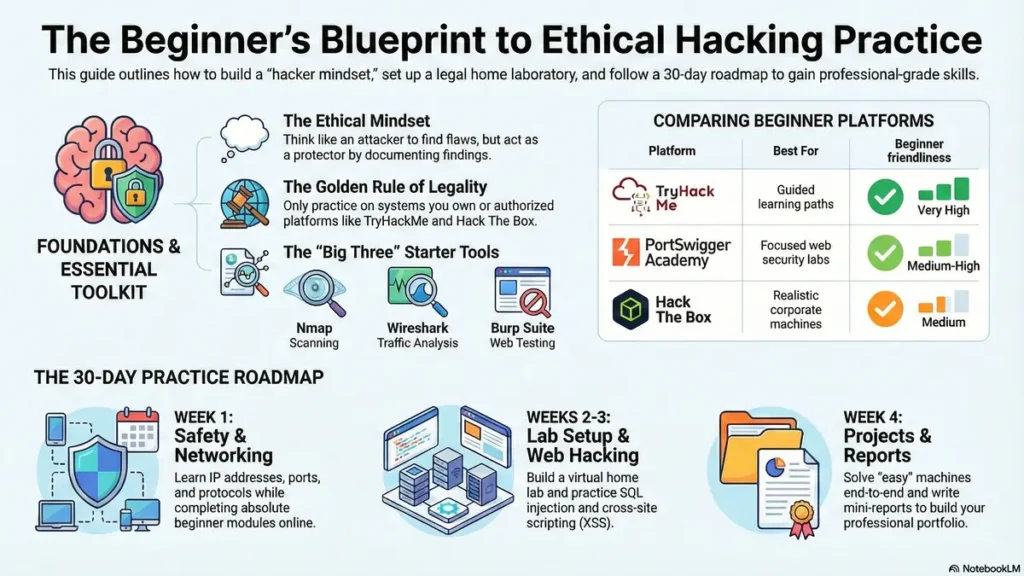
You will learn how to set up a safe lab at home, the use of beginner-friendly practice platforms such as TryHackMe, Hack The Box, and PortSwigger Web Security Academy, and follow a realistic 30-day practice roadmap. Every concept is broken down with examples, checklists, and FAQs so non-technical readers can follow along confidently.
By the end, you’ll know exactly where to practice ethical hacking, which tools to start with, how to avoid legal trouble, and how to turn consistent practice into internships, bug bounties, or a full cybersecurity career.
1️⃣ Why Ethical Hacking Practice Matters Today
The password theft and ransomware that can shut down hospitals, banks, and small businesses have turned cyber attacks into a daily routine. The companies which used to wait for the criminals to attack now hire certified ethical hackers to discover such weaknesses in a controlled permission‑based manner.
The global demand for cybersecurity and ethical hacking practice is growing very fast, and more and more platforms have started offering beginner-friendly labs, virtual machines, and guided paths designed for self-learners and students. That is to say, no longer does one require a computer science degree to get down to practice; rather, he just needs curiosity, discipline, and an appropriate environment.
2️⃣ How To Practice Ethical Hacking Safely (Legally)
Ethical hacking is legal only with explicit permission from the system owner and when in scope. Professional testers will often sign written agreements that describe what to test, when, and with which tools.
As a beginner, you should never scan or attack real websites, Wi‑Fi networks, or applications that you do not own or control, because even “testing” can be treated as unauthorized access under cybercrime laws. Instead, use virtual labs, purpose‑built vulnerable applications, and training platforms that are specifically designed for safe hacking practice.
3️⃣ Hacker Mindset: Think Like An Attacker, Act Like A Protector
Mindset is at the core of the ethical hacking practice: constantly asking “What could go wrong here?” and “How could someone misuse this feature?” Ethical hackers map how data moves, where users log in, and how input is handled, then imagine the easiest ways to break normal assumptions.
Meanwhile, an ethical hacker has to act responsibly: they document steps taken, respect privacy, and report findings in clear detail so the development teams and security teams can fix the vulnerabilities. This blend of curiosity and discipline makes practice far more powerful than just running random tools.
4️⃣ Core Skills You Need Before Practicing
You don’t need to be a programmer or a network engineer to start practicing ethical hacking, but some prerequisites make your learning process much easier. Concentrating on a few topics upfront helps you to understand what your tools are actually doing.
- Basic concepts in cybersecurity: threats, vulnerabilities, exploits, malware, and common attack types like phishing or brute force.
- Fundamentals of networking: IP addresses, ports, protocols such as HTTP, DNS, how data travels across a network.
- Operating systems: feeling comfortable with Windows and especially Linux, because it is the main environment for many hacking tools.
- Light scripting: basic understanding of Python or Bash is sufficient to automate some tasks and understand exploit scripts, but it can be picked up along the way.
Many beginner courses and learning paths bundle these basics alongside practical labs to show you how you can take theory and practice together, rather than waiting until you “know everything.”
5️⃣ Best Ethical Hacking Practice Labs & Websites
Several platforms provide you with safe, isolated environments for ethical hacking practice where you can practice ethical hacking skills legally out against vulnerable machines, web apps, and guided challenges. These platforms simulate real‑world targets but automatically reset, so you can experiment without risk.
| Platform | Best For | Beginner Friendliness |
|---|---|---|
| TryHackMe | Guided virtual labs, beginner attack paths, browser‑based practice. | Very high – lots of hand‑holding and learning paths. |
| Hack The Box | Hands‑on machines, realistic corporate‑style environments. | Medium – better after some basics. |
| PortSwigger Web Security Academy | Web security labs, such as SQL injection, XSS, CSRF, and many others. | Medium to high, with detailed explanations. |
| Internshala | Structured courses besides Labs & certification preparation. | High – Classroom-like guidance. |
| Coursera | Structured courses besides Labs & certification preparation. | High – Classroom-like guidance. |
| Cybrary | Structured courses besides Labs & certification preparation. | High – Classroom-like guidance. |
| Hacking-Lab | Cyber security training labs. | Medium. |
| OverTheWire | War games and command-line hacking challenges. | Medium. |
| PentesterLab | Web security labs. | High. |
| RootMe | Hacking challenges and labs. | Medium. |
| Vulnhub | Downloadable vulnerable virtual machines. | Medium. |
| OWASP Juice Shop | Deliberately insecure web app for practice. | High. |
| Metasploitable | Deliberately vulnerable Linux/Windows VMs. | Medium. |
| Damn Vulnerable Web Application (DVWA) | Deliberately vulnerable web app. | High. |
| WebGoat | Deliberately vulnerable web app. | High. |
| Security Shepherd | Web security challenges. | Medium. |
| CTFtime | Capture The Flag competitions. | Varies. |
| Google CTF | Online Capture The Flag competitions. | Varies. |
| Facebook CTF | Online Capture The Flag competitions. | Varies. |
| Local CTFs and University Labs | Offline hands-on labs and competitions. | Varies. |
Most of these websites provide free tiers or sample labs; therefore, you can try ethical hacking practice without any upfront cost and upgrade only if that style works for you. If you want to grow consistently, choose one leading platform and stick with its learning path, rather than jumping randomly between dozens of resources.
6️⃣ Set Up Your First Home Hacking Lab: Step-by-Step
A home hacking lab is just a private, offline environment where you run virtual machines and vulnerable apps only on your own system or local network. That keeps your practice legal and contained, while still letting you use real tools and real attacks.
Most persons getting started begin with virtualization programs such as VirtualBox or VMware, followed by installing a Linux distribution for tools and one or more intentionally vulnerable targets. Examples include using a security-focused Linux such as Kali, or a standard Linux plus tools, and targets such as Metasploitable, or Damn Vulnerable Web Application (DVWA).
- Create a host‑only or internal network so your lab machines cannot access the internet.
- Install at least one “attacker” machine (your main Kali/Linux box) and one “victim” machine (e.g., a vulnerable web app server) for ethical hacking practice.
- Take snapshots so you can roll back quickly after trying an exploit or configuration change.
This setup allows you to practice scanning, exploitation, and post-exploitation safely over and over again, building real-world skills instead of mere theoretical knowledge.
7️⃣ Beginner‑Friendly Ethical Hacking Tools To Practice
Ethical hacking tools help automate scanning, password testing, network capture, and web exploitation, but they should support your thinking—not replace it. Start with a small toolkit and learn what each tool is designed to do before moving on to more complex frameworks.
- Nmap: Network scanner that discovers devices, open ports, and services on the target system or lab network.
- Wireshark: Packet analyzer that lets you see what traffic is moving across a network in real time.
- Burp Suite (Community): A web proxy that intercepts, modifies, and replays HTTP requests; an essential utility for web application testing.
- Metasploit Framework: A platform used for exploit and payload management against vulnerable systems in a controlled lab environment.
- Wordlists & password tools: Various utilities to test weak passwords and misconfigurations in permission‑based settings.
Most courses and labs for beginners demonstrate, step-by-step, how these tools can be used in a real scenario, such as scanning a vulnerable server and then exploiting a known misconfiguration.
8️⃣ 30‑Day Ethical Hacking Practice Plan (Beginner Roadmap)
A structured 30‑day plan helps you move from “zero” to “I can actually complete beginner labs without copying everything” in a focused way. Each week builds one layer of skill while reinforcing earlier lessons.
Week 1: Basics & Safety
- Read or watch introductions to ethical hacking, legality, and the role of penetration testers.
- Learn basic networking terms, ports, and the idea of client‑server communication.
- Create accounts on a beginner platform like TryHackMe and complete its absolute beginner modules.
Week 2: Lab Setup & Simple Scans
- Install VirtualBox or VMware and set up one Linux attacker machine plus one vulnerable machine.
- Practice the use of Nmap to identify open ports and services running in your lab.
- Experiment with basic Wireshark captures to see what happens when you browse a website or log in to a service.
Week 3: Fundamentals of Web Hacking
- Work through introductory SQL injection and cross‑site scripting labs on PortSwigger Web Security Academy or similar.
- Use the Burp Suite Community Edition to intercept and modify web requests in your lab.
- Document every lab in a simple “what I tried / what worked / what I learned” notebook to build your analysis skills.
Week 4: Mini‑Projects & Reflection
- Pick two or three “easy” machines or rooms from TryHackMe or Hack The Box and solve them end‑to‑end.
- Write a mini‑report for each: overview, methodology, findings, and how to fix the issues.
- Identify gaps, such as Linux commands or web concepts, and draw up a plan for the next month’s learning.
Following a roadmap like this gives you visible progress and material you can later polish into portfolio pieces, blog posts, or LinkedIn write‑ups.
9️⃣ Real‑World Wins: How Practice Turns Into Opportunity
Consistent ethical hacking practice in safe labs can lead directly to internships, bug bounty rewards, and entry‑level roles in security operations or penetration testing teams. Many professionals started as self‑taught learners solving practice machines, sharing write‑ups, and gradually building a portfolio.
Modern training platforms and certification providers increasingly value hands‑on skills and lab performance, not just multiple‑choice exams, making your practice time directly relevant to hiring managers and recruiters.
🔍 Hidden Dangers Of Practicing Wrong (And How To Avoid Them)
Practicing ethical hacking on live systems without permission can trigger legal consequences even if your intention is to “help” or “just test.” In many regions, simply scanning or probing someone else’s website, network, or Wi‑Fi can fall under unauthorized access laws. Another hidden danger is copying exploit steps from videos or forums without understanding the context, which can cause data loss or instability even inside your own environment. Working slowly in isolated labs, taking backups and snapshots, and documenting each action helps protect both your systems and your learning progress.
💡 Ethical Hacking Practice For Non‑Technical People
Non‑technical learners can begin ethical hacking practice by focusing more on visual, guided material and less on complex command‑line usage at the start. Many introductory courses use real‑world metaphors, diagrams, and interactive simulations to explain attacks before diving into tools.
Short, browser‑based labs on platforms like TryHackMe and structured beginner programs on Internshala, Coursera, and Cybrary are particularly suitable, because they provide step‑by‑step instructions and context. Over time, you can add small doses of Linux, scripting, and networking as your confidence grows.
🚀 From Practice To Career: Next Steps & Certifications
Once you have a few months of regular ethical hacking practice, you can start aiming at formal certifications, bug bounties, and entry‑level security roles. Certifications such as vendor‑neutral ethical hacking and penetration testing credentials often build directly upon the tools and skills used in popular labs and courses.
Many career guides recommend a path that mixes theory, practice, and credentials: learn basics, build lab experience, share write‑ups, then pursue relevant certifications as proof of skill to employers. That combination of E‑E‑A‑T—experience, expertise, authority, and trust—is what turns personal practice into professional recognition.
🔥 Ethical Hacking Practice FAQ
- What is ethical hacking practice? Ethical hacking practice means using hacking techniques in safe, permission-based environments—like virtual labs and training platforms—to learn how attackers think and how to protect systems.
- Is ethical hacking practice legal for beginners? Ethical hacking is only legal when you hack systems you own or those that explicitly allow testing, such as official labs, bug bounty programs, or approved corporate engagements.
- Do I need to know coding before I start? You can begin ethical hacking practice with minimal coding knowledge by using guided labs and visual tools, then gradually learn simple scripting as you progress. .
- What’s the safest way to do ethical hacking at home? The safest option is to run virtual machines on your computer and connect them via an isolated lab network with vulnerable targets set up with training in mind.
- Which websites are best for ethical hacking practice? The beginner-friendly options include TryHackMe for guided rooms, Hack The Box for more realistic machines, and PortSwigger Web Security Academy for focused web security labs.
- How long does it take to see progress? With regular daily or near-daily practice, many beginners start solving easier machines and labs independently in about one to three months. The key is not speed, but rather consistent effort, reflection, and revisiting topics that felt confusing the first time.
- Can non‑technical students learn ethical hacking? Well, yes, non‑technical students can learn all about ethical hacking with courses that are targeted at beginners, explaining networking, web basics, and security concepts from scratch. This group will especially benefit from choosing resources that use plain language, diagrams, and interactive labs.
- Which tools should I start practicing with? Most newcomers to the practice of hacking begin with Nmap for scanning, Wireshark for traffic analysis, and Burp Suite Community for web testing, often within pre‑built lab exercises. As you become more confident, you add Metasploit and other specialized tools to your practice toolkit.
- Is Kali Linux necessary for ethical hacking practice? Kali Linux is popular because it bundles many security tools, but it is not mandatory; you can install similar tools on other Linux distributions or even use cloud‑based labs. What matters more is understanding how the tools work and using them safely within your lab.
- How can I avoid accidentally attacking real systems? Set up your home lab to utilize host‑only or internal networking, and reconfirm that target IP addresses belong to your virtual machines or are part of an authorized training platform. Do not scan unknown external IP ranges or domains without explicit permission from a program or provider.
- Do free practice resources about ethical hacking suffice? Free resources will surprisingly get you a long way, with many platforms offering entire beginner paths and dozens of labs without charge. Paid courses only then become more useful once you want structured guidance, mentorship, or preparation for specific certifications.
- How do I track my ethical hacking practice progress? Keep a simple log or journal where you record which labs you attempted, what worked, what failed, and what you learned. Over time, this becomes a personal knowledge base, and can be turned into portfolio write‑ups or blog posts.
- What is the difference between ethical hacking practice and real‑world pentesting? Most lab practice focuses on isolated machines or vulnerabilities, while real‑world engagements involve scoping, communication with clients, reporting, and integrating findings with business risk. Many of the same tools and techniques carry over directly once you understand the bigger context.
- Can ethical hacking practice help in bug bounty programs? Yes, many bug bounty hunters first started off solving web security labs and practice machines to learn common vulnerability patterns. Once you are able to reliably find and exploit bugs in labs, those skills translate to real programs that invite you to test their systems under certain rules.
- Is certification necessary if I have strong practice skills? Certifications are not strictly necessary but, in conjunction with visible practice projects and lab achievements, they do help validate your skills for employers. Most career guides recommend doing both: real hands‑on experience plus at least one recognized credential.
- How to Choose Your First Ethical Hacking Course? Look for a course that overtly enumerates prerequisites, includes labs or virtual practice, and is updated recently rather than relying on outdated material. Reviews, sample lessons, and alignment with credible certifications will help you make your decision.
- What common mistakes should beginners avoid? Typical mistakes include going directly to advanced tools without basics, copying commands with no understanding, and experimenting on live systems without permission. The other common mistake is constantly changing platforms rather than completing one path for beginners to the end.
- How much hardware do I need for a home lab? Generally, a mid‑range computer would easily suffice for early practice, provided it has enough RAM and storage to run two to three virtual machines comfortably. As you advance, you can upgrade or move some lab work to cloud‑based environments that training platforms provide.
- Can school or college students start ethical hacking practice? Absolutely—the resources are targeted to students, and most of them have learning pathways that can be fit into an academic schedule. An early start with basics and simple labs may give a student the edge they need at graduation.
- What do I do next after I have read this guide? The next best steps include the creation of accounts on one or two recommended platforms, setting up a minimum home lab, and dedicating oneself to a 30‑day practice schedule. Along the way, be sure to check out detailed tutorials, deep‑dive articles, and practical walkthroughs on blogs dedicated to cybersecurity and ethical hacking.
A Certified Ethical Hacker (CEH) is a cybersecurity professional who is trained to legally break into systems, networks, and applications to find security flaws, just like a malicious hacker would, but with the organization’s permission. The goal is to improve security, not harm it.
Stay Connected with My Coding Journey
Don’t let scammers stop your professional growth. Join our community for more tech safety tips!
For more tutorials and guides, check out: CodingJourney.co.in