
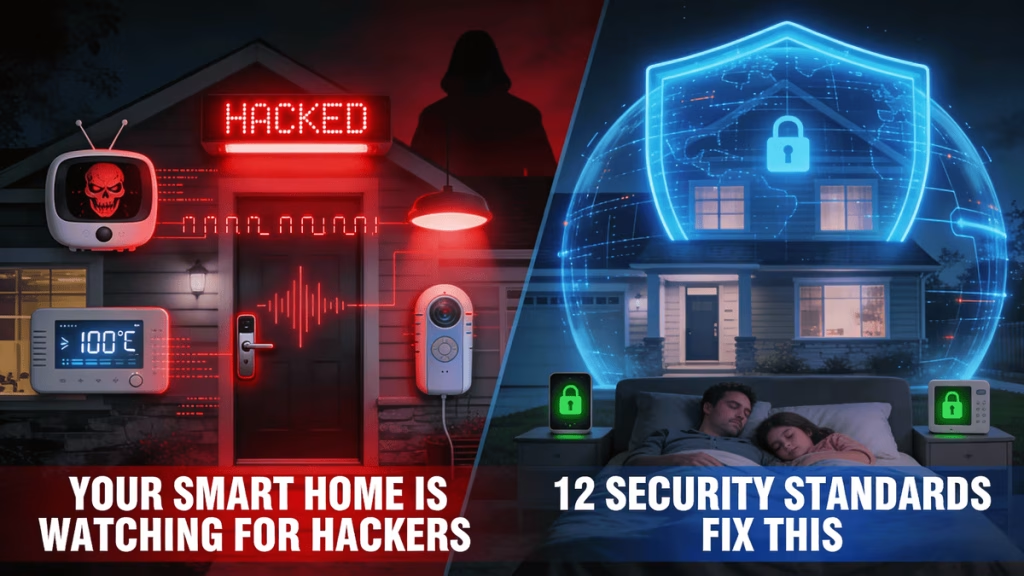
IoT device security standards may be the furthest thing from your thoughts when you are getting ready to relax for the evening thinking that your smart home is a safe haven. Out of the blue, your thermostat goes to the max, lights act strangely, or to make it worse, a voice comes out of your kid’s baby monitor. This is not a film – it is the reality of unsecured connected devices.
The smart convenience that we are fond of is, in fact, hiding wide open digital doors. Manufacturers frequently rush products to market, feature-focused and safety-ignored, thus leaving your personal life exposed to invisible digital trespassers.
The good thing, however, is that this digital mess does not have to be your fate. By comprehending and insisting on strong IoT device security standards, you will be able to close those digital doors and get back control of your connected world.
Table of Contents
- What Are IoT Device Security Standards Really?
- Why IoT Device Security Standards Are Often Ignored
- A Real-World Nightmare When IoT Device Security Standards Fail
- Decoding Common IoT Device Security Standards
- How AI Exploits Weak IoT Device Security Standards
- Essential IoT Device Security Standards for Home Users
- Critical IoT Device Security Standards for Businesses
- Your Checklist to Verify IoT Device Security Standards
- The Grim Consequences of Ignoring IoT Device Security Standards
- The Future Landscape of IoT Device Security Standards
- Frequently Asked Questions About IoT Device Security Standards
1. What Are IoT Device Security Standards Really?
Sarah bought a smart plug, set it up, and it simply worked. It never occurred to her that “working” might involve security until she came across a story about hackers using similar plugs to gain access to home networks. She understood that she didn’t know what rules, if any, her new gadget was following to keep her safe.
Security standards for IoT devices are basically the rule book that manufacturers need to follow in order to make their products less vulnerable. They specify
- Strictly unique passwords for each device right from the factory.
- Protocols for encrypted communication between the device and the cloud.
- Obligations for software to be regularly and authentically updated.
- Ways to verify the identity of users in a secure manner before giving access.
Sarah’s plug was comfortable because it threw these complicated rules out the window. Without compliance with IoT device security standards, user-friendliness is frequently a direct way to a device being easily hackable.
These standards serve as a barrier to the quality of the product. They make sure that the digital locks on your gadgets are real and not just there for show.
The Role of Encryption in IoT Device Security Standards
Mark thought that the video feed from his smart doorbell was confidential. He was shocked to learn that if there are no proper encryption standards, anyone can take a peek at his unboxing and goings just by using simple network tools.
Proper encryption is one of the essential elements in the security standards of IoT devices. It guarantees
- Data that is sent over Wi-Fi cannot be read by eavesdroppers.
- Information kept in the cloud is encrypted to prevent breaches.
- Commands that are given through your phone cannot be taken over by hackers.
- Firmware updates are checked and not tampered with during the delivery.
- Personal identifiers are converted into a different string and are safe.
In the absence of encryption requirements in IoT device security standards, your data is like a person without clothes traveling across the internet.
It is a good practice to always be sure that your equipment is using encryption protocols that are up to the industry standards such as TLS or AES in order to make your private moments really private.
2. Why IoT Device Security Standards Are Often Ignored
A manager of a factory purchased 50 cheap environmental sensors with the intention of using them to monitor the humidity level. Apart from being inexpensive, they were very easy to deploy. After some months, he realized that all the sensors were using the username admin and password password, something that he had completely overlooked during the installation because the devices just worked.
There is a plethora of cheap devices in the market resulting from manufacturers who ignore stringent security standards for IoT devices in order to save costs. Some of the main reasons for this omission are
- Being under pressure to release products before competitors do.
- High cost of security specialized engineers hiring.
- Thinking that one’s device is too little to be hacked.
- Limited processing power of small devices which makes running security hard.
- Lack of consumer awareness in order to demand better security.
The factory manager put cost and speed before safety. Such an attitude, which is dominant among both buyers and sellers, is one of the reasons why IoT device security standards are being undermined.
Perhaps the most significant drawback of IoT, which is its set it and forget it nature, is still security. Security needs continuous involvement that are not designed to receive by cheap devices.
The Trap of Default Passwords and IoT Device Security Standards
Lisa was setting up her new router but got stuck. According to the instructions, both username and password were ‘admin’. She laughed to herself, thinking that her neighbor’s router must be using the same exact credentials, hence it would be very easy to access.
Using default credentials is a direct breach of basic IoT device security standards. This practice continues because
- It makes the first-time user setup process very easy.
- It lowers customer support call volumes due to forgotten password issues.
- Manufacturers assume that users will change them immediately.
- Mass production is more economical with identical firmware images.
- There is an absence of regulated enforcement that prohibits this practice.
Any device that has a universal default password is essentially failing the most basic test of modern IoT device security standards.
It should be an absolute rule that default credentials are changed before the device is even connected to the wider internet.
3. A Real-World Nightmare When IoT Device Security Standards Fail
The casino was very modern and appeared to be secure. However, hackers were able to steal their high-roller database. How did they get in? A fish tank thermometer in the lobby that was connected to the internet and didn’t have any security features, thus, the attackers were able to move to the main network.
This landmark event demonstrates that a chain is only as strong as its weakest link. When IoT device security standards are neglected on devices that are just lying around, a catastrophe will inevitably happen.
- Insecure cameras are being utilized to watch families in their homes without their knowledge.
- Smart toys are being hacked so that they can communicate with children.
- Devices such as pacemakers are having their theoretical vulnerabilities exposed.
- Researchers have been able to remotely disable connected cars.
- Some simple sensors have been used as a gateway to infiltrate industrial control systems.
The fish tank story is not an exception – it is a warning. Not paying attention to IoT device security standards for any device means putting your whole network in jeopardy.
Vulnerabilities are not going to be confined in one place. They are openings that attackers exploit for lateral movement to more valuable resources, be it personal photos or corporate data.
Botnets and the Absence of IoT Device Security Standards
James noticed that his internet was incredibly slow. He didn’t realize his six-month-old security camera, which he never updated, had been enslaved into a massive botnet. His device was now part of a global army attacking others without his knowledge.
Botnets thrive in environments devoid of IoT device security standards. They grow by
- Scanning the internet automatically for vulnerable devices.
- Using dictionary attacks on default credentials.
- Exploiting unpatched software vulnerabilities instantly.
- Installing malware that runs silently in the background.
- Using the device’s bandwidth for DDoS attacks.
The lack of adherence to IoT device security standards, such as automatic updates, makes creating these zombie device armies trivial for attackers.
Ensuring your devices can and do update automatically is your primary defense against becoming an unwitting accomplice in cybercrime.
4. Decoding Common IoT Device Security Standards
It feels like trying to find your way through the technical landscape of security regulations is a daunting task. You spot acronyms like NIST, ETSI, and ISO being used, but what impact do they really have on the smart speaker that is just sitting there on your kitchen counter?
There is not a single global law, but several main frameworks lay down the norms for IoT device security standards of the future
- ETSI EN 303 645 A primary European standard concentrating on consumer IoT minimal security provisions.
- NIST IR 8259 Series Guidance from the U.S. government for the manufacturers on the security features at the core level.
- ISO/IEC 27001 A general information security standard that companies use to secure their IoT processes.
- OWASP IoT Top 10 Not a standard, but a very important awareness document that identifies the biggest threats in the IoT field.
- ioXt Alliance An industry-led certification program to ensure security compliance in IoT.
Knowing that these frameworks are there is the first step. They represent the standards against which we can evaluate a manufacturer’s pledge of security in IoT devices.
You are not supposed to memorize them, but it is helpful enough to know that you should check for certifications like ioXt certified or ETSI EN 303 645 compliance when deciding what to buy.
OWASP IoT Top 10 and IoT Device Security Standards
A developer was designing a new smart switch. Rather than guessing at security, she referred to the OWASP IoT Top 10 list. It showed her right away the exact traps that she needed to avoid, thus saving her from the release of a product with a security flaw of a high degree.
The OWASP IoT Top 10 is a core instrument to grasp the mishaps of security of IoT devices as per the security standards. It points to the hazards such as
- Weak, guessable, or hardcoded passwords.
- Insecure network services that are running unnecessarily.
- Insecure ecosystem interfaces – web, backend API, cloud.
- Absence of secure update mechanisms.
- Usage of insecure or obsolete components.
By concentrating on these ten points, developers can be a good deal closer to complying with tight IoT device security standards.
For the consumers, this catalog is a set of warning signs showing the potential risks resulting from manufacturers who take security for granted.
5. How AI Exploits Weak IoT Device Security Standards
Normally, we would consider AI as a tool for defense, but the truth is cybercriminals are also leveraging it. Just think about an automated system that not only doesn’t simply scan for open ports but also can smartly predict passwords based on device models, and that too much faster than any human.
Artificial intelligence is weaponizing the absence of security standards for IoT devices at an unheard of speed and scale
- AI algorithms can produce millions of potential password variations in order to break weak credentials.
- Machine learning models study network traffic to pinpoint the types of devices that are vulnerable.
- AI-powered chatbots compose highly persuasive phishing emails in order to obtain IoT access credentials.
- Automated systems go through code repositories in order to find unpatched vulnerabilities in IoT software.
- AI can impersonate normal user behavior in order to trick anomaly-based detection systems.
The advent of AI-based attack tools along with inadequately secured IoT devices has resulted in a dangerously unstable threat landscape.
The defenses have to be upgraded very quickly. To be able to match the pace of AI-powered attacks targeting our dumb smart devices, we have to use AI-powered security systems now.
AI-Powered Defense and IoT Device Security Standards
Thousands of sensors monitor temperatures in a very large data center. An AI system spotted a sensor that was behaving a little bit differently – not a malfunction, just strange. It moved the unit to a different location on its own just a couple of seconds before the sensor tried to carry out a harmful payload.
AI is turning out to be necessary for the implementation and supervision of security standards for IoT devices in real-time. It is very helpful in the following ways:
- By creating baselines for normal device behavior so that anomalies can be detected immediately.
- By performing in a fully automatic manner vulnerability patches on thousands of devices at the same time.
- By foreseeing possible attack vectors before the attackers have a chance to use them.
- By going through huge volumes of log data in order to find very faint signals of a break-in.
- By verifying devices through their behavior patterns rather than just using static keys.
Nevertheless, AI is the only method that can potentially secure standards for IoT devices in huge networks at a global level, even though it is the main factor behind the new wave of attacks.
The IoT security situation will be a battle of AI vs AI where no human intervention is necessary. One side will be automated defense systems while on the other will be automated attackers.
6. Essential IoT Device Security Standards for Home Users
Once you’ve bought a new smart TV, connected it with Wi-Fi and signed into streaming services, it appears to be secure in your living area. Nevertheless, a TV without security features is just a computer on your network which you have limited control over.
Users of home technology are responsible for managing their own IT. It is very important to implement basic security standards for IoT devices in the household.
- Change Defaults Immediate change of all default usernames and passwords is necessary.
- Enable 2FA Use Two-Factor Authentication on all associated apps and accounts.
- Separate Networks Allow IoT devices to access a Guest Wi-Fi network that is separated from the network of your main computers.
- Update Regularly Every single device should have automatic firmware updates enabled.
- Disable Features On your router, turn off UPnP Universal Plug and Play.
By putting these standards into practice for your home-based IoT devices, you are drastically narrowing your attack surface.
It converts your smart home from being vulnerable to becoming a fortified one that most of the opportunistic attackers will simply walk away from.
One of the most terrifying experiences a family can have is when a stranger talks to their child through a smart monitor that was hacked. They found out the hard way that no one had changed the default password and thus the digital door was left wide open for intruders.
Among all types of devices, cameras are the most privacy-sensitive ones. There is no negotiation that IoT device security standards need to be applied here.
- Do not ever opt for the default password that comes with the camera.
- Make sure that the camera feed is secured with encryption from end to end.
- Create a unique and complex password that is used nowhere else and is not known by anyone.
- Do not let the camera’s firmware become outdated, always update it.
- If you are only using remote viewing when you are at home, it is better to turn it off.
Not securing cameras with IoT device security standards is not only a data risk, but a very serious physical privacy disservice.
Think of a smart camera as a guest you have invited into your home – one that you need to thoroughly vet and make sure it is not causing harm by monitoring it constantly.
7. Critical IoT Device Security Standards for Businesses
Once you’ve bought a new smart TV, connected it with Wi-Fi and signed into streaming services, it appears to be secure in your living area. Nevertheless, a TV without security features is just a computer on your network which you have limited control over.
Users of home technology are responsible for managing their own IT. It is very important to implement basic security standards for IoT devices in the household.
- Change Defaults Immediate change of all default usernames and passwords is necessary.
- Enable 2FA Use Two-Factor Authentication on all associated apps and accounts.
- Separate Networks Allow IoT devices to access a Guest Wi-Fi network that is separated from the network of your main computers.
- Update Regularly Every single device should have automatic firmware updates enabled.
- Disable Features On your router, turn off UPnP Universal Plug and Play.
By putting these standards into practice for your home-based IoT devices, you are drastically narrowing your attack surface.
It converts your smart home from being vulnerable to becoming a fortified one that most of the opportunistic attackers will simply walk away from.
One of the most terrifying experiences a family can have is when a stranger talks to their child through a smart monitor that was hacked. They found out the hard way that no one had changed the default password and thus the digital door was left wide open for intruders.
Among all types of devices, cameras are the most privacy-sensitive ones. There is no negotiation that IoT device security standards need to be applied here.
- Do not ever opt for the default password that comes with the camera.
- Make sure that the camera feed is secured with encryption from end to end.
- Create a unique and complex password that is used nowhere else and is not known by anyone.
- Do not let the camera’s firmware become outdated, always update it.
- If you are only using remote viewing when you are at home, it is better to turn it off.
Not securing cameras with IoT device security standards is not only a data risk, but a very serious physical privacy disservice.
Think of a smart camera as a guest you have invited into your home – one that you need to thoroughly vet and make sure it is not causing harm by monitoring it constantly.
Industrial IoT IIoT and IoT Device Security Standards
An oil refinery relied on sensors to keep track of the pressure in the pipeline. The attackers altered the sensor data feeds, which misled the control systems to increase the pressure in a part of the pipeline excessively, thus resulting in physical damage and a shutdown.
In the case of Industrial IoT, the security standards of IoT devices if not met, may cause the physical destruction of the facility and safety hazards. Some of the key areas of focus are
- Compliance with IEC 62443 standards for industrial automation.
- Disconnecting (air-gapping) the critical operational technology (OT) networks from the IT networks.
- Making sure that there are fail-safe mechanisms to take over if the digital controls are hacked.
- In some situations, giving more importance to the availability and integrity of data rather than confidentiality.
- Implementing the use of ruggedized equipment that is built to resist physical attacks.
Industrial environments call for special IoT device security standards where the protection of the cyber realm must not be at the expense of physical safety.
The integration of IT and OT networks is a call for a combined, stringent, and well-standardized security measure approach.
8. Your Checklist to Verify IoT Device Security Standards
You have a box for a new smart gadget in your hand at a store. The device seems to be nice, but how do you know if it’s a digital waste or a safe product? You’re not allowed to check the code, but you may search for red flags and green lights.
Such an efficient checklist should be used to measure conformity to IoT device security standards before and after a purchase
- Pre-Purchase Brand Reputation A quick search can show whether there were security scandals recently, or a good track record for fixing issues?
- Pre-Purchase Update Policy Is it the manufacturer who clearly states how long they will provide security updates e.g. a 5-year guarantee?
- Pre-Purchase Privacy Policy Is the policy written in a way that is understandable? Does it explicitly state that they will not sell your personal data to third parties?
- Pre-Purchase Certifications On the box or site, look for labels such as ioXt Certified.
- Setup Forced Password Change Is it the device that forces you to change the default password at first use? It is a very good sign.
This checklist allows you to overcome marketing hype and evaluate the truth of a product’s IoT device security standards.
The best long-term protection becomes you when you turn into a critical consumer. Do not let digital trojan horses enter your home or business.
Recognizing Secure IoT Packaging and Marketing
While browsing online, you find two similar products with one costing 10 more. The cheaper one talks about an easy setup, while the expensive one simply states end-to-end encryption and security updates by the minute. Which one would you pick?
Secure marketing is becoming one of the factors that distinguish a product. These are some of the signs of security IoT device standards to watch out for
- Explicit mention of encryption protocols e.g. AES-256, TLS 1.3.
- Unambiguous statements about the security update time e.g. Security patches until 2028.
- Links to transparency reports or security whitepapers.
- Third-party security testing labs badges.
- Privacy-focused features rather than giving privacy as an afterthought.
In most cases, when a company is loudly advertising its compliance with IoT device security standards, it is a signal that they have made a substantial investment in your protection.
Use a few extra dollars to buy the product that takes your digital safety seriously. It is much cheaper than the process of identity theft recovery.
9. The Grim Consequences of Ignoring IoT Device Security Standards
It was just a small thing – the smart lights in his home flickered occasionally. After that, his bank account was emptied. When the police looked into it, they found that his cheap smart plug had a security hole that allowed the hackers to access his network. From there, they put keyloggers on his computer, which recorded everything he did on his bank account.
The consequences of not following security standards for IoT devices are very serious and can spread in all directions.
- Severe Financial Loss Direct theft of funds, ransomware payments, or expenses related to the recovery of the stolen identity.
- Complete Loss of Privacy Personal, private moments recorded on video or audio, and then released on the internet or used for blackmail.
- Physical Safety Risks Unlocked doors for physical entry or heating systems that have been manipulated to cause danger.
- Operational Shutdowns Businesses that stop completely because of ransomware that has come through IoT side doors.
- Legal and Regulatory Fines Companies that are heavily fined under GDPR or CCPA because of data breaches that started from IoT.
Not taking seriously the security of IoT devices is not putting the risk on hold – it is actually inviting disaster. The consequences are much more than just a broken device.
The price of not being secure is always higher than the price of putting the standards in place upfront.
Data Privacy vs. IoT Device Security Standards
One user discovered that their anonymized usage data of a smart vacuum were sold to advertisers who then linked it back to their real identity. Although the device was secure from hackers, the company’s privacy practices were terrible.
Security and privacy are interrelated but different aspects of the security standards of IoT devices
- Security concerns the protection of data from unauthorized access or hackers.
- Privacy concerns the authorized entity (the manufacturer) and the way it handles your data.
- It is possible for a device to be secure from the outside world, but still, infringe on your privacy by excessive data collection.
- Strong standards should not only consider the measures to prevent hackers from accessing the device but also the limitations on the manufacturer’s data.
- Find devices that perform data processing locally at the edge rather than that send everything to the cloud.
You cannot have real privacy without security, and security without privacy is just a beautiful prison. IoT device security standards must include both.
Always wonder why a device needs the data it is requesting. If a smart toaster requires your location data, then that is a privacy red flag.
10. The Future Landscape of IoT Device Security Standards
We are at a crossroads. The current IoT wild west can no longer last. Governments, industry leaders, and consumers are no longer turning a blind eye to the fact that voluntary standards are not enough. The future is heading towards mandatory compliance.
New developments in government regulation, standardization, and technology will radically transform the landscape for IoT security standards.
- Government Regulation Laws such as the EU Cyber Resilience Act will make it mandatory to have a minimum level of security in order to enter the market. It will be illegal to sell insecure products.
- Standardized Labeling In the same way as nutrition labels on food, IoT devices will have security labels that will inform the user about the protection level, the update policy, and the data practices.
- Liability Shifts Legislation may change the liability for breaches to manufacturers if they fail to meet security standards thus putting an end to the era of negligence without consequences.
- Security as a Service The security of IoT will be less and less the concern of individuals but rather AI-driven cloud services will take care of monitoring and protecting devices automatically.
- Blockchain for Integrity Distributed ledgers may serve as a means to verify firmware updates and also be used as a permanent record of device identity.
The future of IoT device security standards is moving from nice to have to legally required. This change will be difficult for those who produce cheap products but necessary for a safe connected society.
To know more about technology trends that lead to this future, you can trust codingjourney.co.in to be a great source of information.
Professional Cybersecurity Services
We are moving toward a world where purchasing a toaster won’t require you to be a cyber-expert. Security won’t be an afterthought anymore; it will be there from the start.
Consumer Power in Shaping IoT Device Security Standards
One major camera manufacturer experienced such a backlash, including boycotts, after their attempt to charge a subscription for basic security features that they had to quickly reverse their decision. This demonstrated that companies do respond when consumers make their purchasing decisions accordingly.
Eventually, the greatest power to enforce higher IoT security standards resides with you, the end user.
- Just stop buying the cheapest and unauthenticated smart home products from no-name online stores.
- If a product doesn’t support basic security features like 2FA, then you should leave a negative review.
- Ask companies on social media about their security update policies.
- Help brands that are honest about their security measures and have the necessary certificates.
- Be prepared to pay a little extra for devices that take security engineering into account.
The manufacturers will only start to focus on the security of IoT devices when they realize that it is affecting their profits if they do not do so.
Sometimes you can find good local tech support for secure configurations through directories like codingjourney.sulekha.com in case you need some practical assistance.
Be the one who leads the market towards safety. Insist on better, more secure products, and the industry will have no other option but to supply them.
Frequently Asked Questions About IoT Device Security Standards
- What are the basic IoT device security standards I should look for? Changeable passwords, encrypted data, automatic updates, and two-factor authentication support should be checked.
- Why do many devices ignore IoT device security standards? Manufacturers find it cheaper and faster to deliver products without a robust security feature, hence they do not give much thought to security.
- Can I apply IoT device security standards to old devices? Most times you cannot. A device that does not get updates cannot comply with current standards and needs to be replaced.
- Are there official laws for IoT device security standards? Yes, the UK PSTI Act and the EU Cyber Resilience Act are some examples of the legislations that are making certain standards mandatory.
- How do IoT device security standards protect my privacy? These standards require encryption of data and set rules for manufacturers to have clear policies that do not allow them to misuse your personal information.
- What is the risk of ignoring IoT device security standards at home? Hackers could invade your privacy, make off with your sensitive data, or employ your devices in botnet attacks.
- Do businesses need different IoT device security standards than homes? Indeed, businesses require more stringent measures such as network segmentation, zero trust, and continuous monitoring.
- What is the most common violation of IoT device security standards? One of the most frequent violations is the use of hardcoded, universal default passwords such as admin/admin without change.
- How does AI affect IoT device security standards? AI, on the one hand, is employed by the attackers to identify vulnerabilities and, on the other hand, by the defenders to security monitoring automation.
- Does a high price guarantee good IoT device security standards? Not necessarily, but very cheap and unbranded products almost always take security standards for granted.
- What is the ETSI EN 303 645 standard? It is a leading European standard that clearly defines minimum security requirements for consumer IoT devices.
- How often should devices update to meet IoT device security standards? Updates should be performed whenever a security flaw is identified – it is best to have updates done automatically.
- Can a router help enforce IoT device security standards? Definitely, a well-secured router with guest networks and firewalls is very important in the isolation of risky IoT devices.
- What if a manufacturer decides to no longer adhere to IoT device security standards? The device will forever be susceptible to new threats and it should be unplugged from the network.
- Are smart toys covered by IoT device security standards? Yes, In fact, they are very important because, in the event of a breach, it involves not only the privacy but also the safety of children.
- What role does encryption play in IoT device security standards? Encryption converts data into a form that cannot be understood or used by others, even if they intercept the data.
- What is a botnet in the context of IoT device security standards? A botnet is a group of compromised IoT devices controlled by criminals to perform massive attacks. The botnet concept is a result of poor security standards.
- How do I check a device’s IoT device security standards before buying? Look up the brand’s security record, check for security certification labels on the package, and review their privacy policy.
- Will future IoT device security standards be mandatory? The trend is strongly moving towards device security being regulated by laws imposed by governments.
- What is the Matter standard’s role in security? Matter is a compatibility standard that has baseline security requirements as one of the mandatory features for certified devices.


