
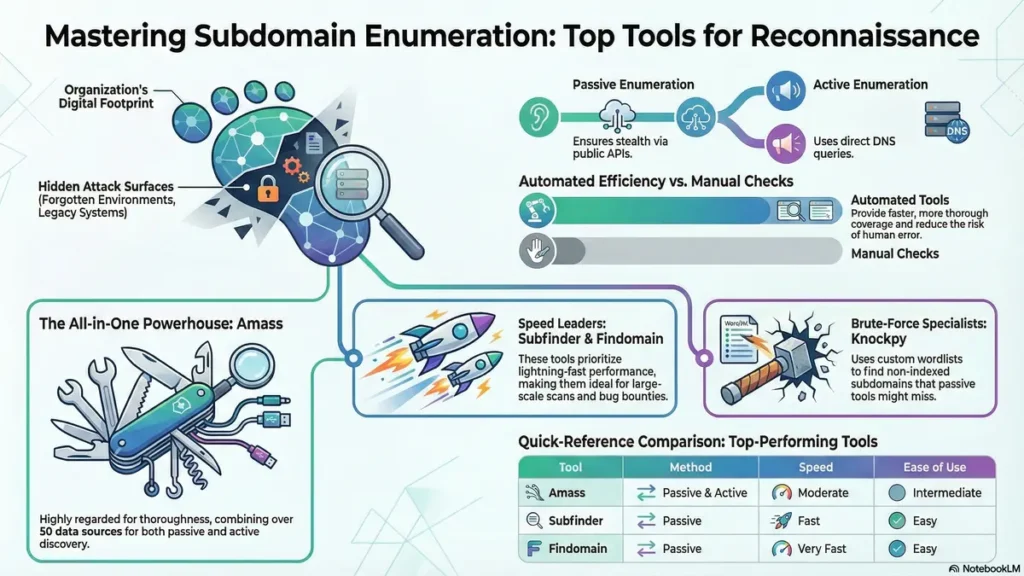
Best subdomain enumeration tool is an essential part of every cybersecurity professional’s or ethical hacker’s toolkit if they want to figure out the hidden assets and possible vulnerabilities of the target domain.
Whether you are doing penetration testing or just performing reconnaissance, it is of no use if you do not have the right tool to be the factor that results in the discovery of valuable subdomains that you might not have seen otherwise. The best subdomain finder tools, in either cases of open-source solutions or solid commercial platforms, deliver you with speed, accuracy, and completeness of the results so that you can be a step ahead in your security assessments.
The article discusses the best tools for identifying subdomains, comparing their features, and assisting you in selecting the appropriate tool for your workflow.
Table of Contents:Best Subdomain Enumeration Tool
- Introduction:Best Subdomain Enumeration Tool
- Why Subdomain Discovery Matters
- Best Subdomain Enumeration Tool Overview
- Feature Comparison:Best Subdomain Enumeration Tool
- How to Choose:Best Subdomain Enumeration Tool
- FAQs:Best Subdomain Enumeration Tool
- Conclusion:Best Subdomain Enumeration Tool
Introduction:Best Subdomain Enumeration tool
It is imperative to record information at the very start of a security assessment. A powerful subdomain scanner is capable of exposing the digital assets that are not obvious.
If you are a penetration tester, a bug bounty hunter, or a network administrator, choosing an efficient information gathering tool can be the most important step for conducting a thorough attack surface analysis.
The first thing to consider when evaluating the best subdomain enumeration tool should be its speed and the thoroughness of the discovery process.
Why Subdomain Discovery Matters
- Subdomain discovery discloses those hidden assets which are the possible entry points of the attackers.
- Numerous subdomains are hosting the development or staging environment with the security that is not so strong.
- Old systems are usually on subdomains, thus, the risk of these vulnerabilities is getting higher.
- Knowing all subdomains reduces the attack surface.
- Unnoticed subdomains may be the sources of unauthorized access to data.
- Thorough subdomain enumeration empowers an organization’s security to higher levels.
- Automated tools do the job of discovery much faster.
- Automation secures a more thorough coverage in comparison with manual checks.
- The security team through efficient subdomain enumeration is able to free up time of their work.
- Regular scans of subdomain contribute to the maintenance of current security assessments.
- Subdomain discovery is one of the requirements for penetration testing and red teaming.
- It assists in the uncovering of the forgotten as well as the misconfigured endpoints.
- Subdomains identification is helpful in following security standards.
- It enables a company to be ahead in threat hunting and ready for incident response situations.
- Subdomain enumeration tools can provide information about the integration of third-party services which might have some risks.
- They help in the preparation of a complete map of the organization’s digital footprint.
- Automated tools can connect with other security operations for the ease of work.
- They lessen the chances of human mistakes in the process of discovery.
- Subdomain enumeration is one of the factors that ensure continuous monitoring and risk management.
- Discovering the right subdomain enumeration tool is the main factor in thorough and efficient reconnaissance.
Best Subdomain Enumeration Tool Overview
Amass: The Powerhouse for Subdomain Discovery
Amass is one of the best subdomain enumeration tools that can be used for both passive and active reconnaissance in order to cover the maximum area.
As a result of its open-source nature, Amass utilizes more than 50 data sources such as DNS, certificate transparency logs, web archives, and APIs to provide the most accurate and complete picture possible.
In fact, its features like recursive subdomain discovery, brute-force enumeration using custom wordlists as well as the visualization of network assets are what make most cybersecurity professionals choose it as their tool of the trade. Plus, Amass has a graph database to record changes over time and offers a variety of detailed output formats which assure that it is usable both in automated workflows and manual analysis.
Subfinder: Speed and Efficiency for Large-Scale Scans
Subfinder has been praised for its fast and efficient performance, which is what makes it an excellent tool of subdomains enumeration for a large-scale descriptive task. This is a subdomain enumeration tool that enjoys the most success in a passive mode by using the least set of public sources that are chosen, and therefore, it achieves fast and reliable results.
Due to the simple command-line interface and the lightweight design, users are able to quickly scan multiple domains with minimal setup through Subfinder. Although it cannot be said to have the same level of coverage as Amass, its great performance in situations where time is a factor, such as bug bounty programs or penetration tests, is the reason why it is adopted by lots of security experts as their first line of attack.
Sublist3r: Quick Insights from Multiple Sources
Sublist3r is an exhaustively diversified tool which collects the subdomain information by means of quite a few publicly available sources. These sources are search engines, DNS records and certificate transparency logs. It offers an extremely efficient and convenient method to see the target’s online presence.
If you want to have a brief look at the situation, Sublist3r is the right choice. Moreover, it has become a front-runner tool in subdomain enumeration, both in the case of novices and experienced professionals, who want to get quick output, due to its great work and foolproofness.
Censys: Advanced Passive Discovery and Data Integration
Censys has the power of an extensive internet-wide scan to provide advanced passive subdomain discovery. Through the access to the detailed information about hosts, services, and certificates, users can unveil the subdomains which are less interacted with.
Security researchers, in particular, benefit a lot from Censys since they can collect the needed intel without giving the target an alert, thereby, Censys being an immensely effective subdomain reconnaissance tool for non-intrusive reconnaissance because it is a thorough data integration tool.
Findomain: Lightning-Fast Enumeration with API Support
Basically, Findomain is known for its extremely fast performance and very good API integration which is main reason why it is ranked as a number one tool for users who are in need of speed and automation.
The tool for discovering the online subdivisions i.e. subdomain enumeration that Findomain is, goes on and fetches the subdomain from a great many sources of data in order to do it very fast and it also is very friendly in terms of different output formats thereby it could be easily merged or integrated with any other security tools.
Findomain’s performance and stability have been the main reasons for its popularity to be widely used by solo researchers and enterprise security teams.
SecurityTrails: Comprehensive Data and Historical Insights
SecurityTrails is the gateway to one of the largest DNS and subdomain records databases worldwide, with an extensive range of both live and historical data. By using its exceptional API and user-friendly interface, customers can find unlisted resources, monitor their evolution and get deep insights into the target’s network.
SecurityTrails is an excellent source of information for security threats mitigation, incident handling, and resource tracking purposes, hence an indispensable tool in the security arsenal for performing subdomain enumeration.
Knockpy: Brute-Force Subdomain Enumeration
Knockpy is mainly focused on brute-forcing subdomains with the help of custom wordlists to locate those subdomains which are not indexed or are little known. Such a method harmonizes with passive discovery tools by revealing the assets that could have been left unfound.
Due to the availability of a good interface and the possibility of customization, Knockpy is friendly both to a novice and an experienced user thus it is always a trustworthy way to carry out a deep subdomain enumeration.
DNSRecon: Flexible and Scriptable Enumeration
DNSRecon is an adaptable instrument that can perform detailed DNS enumeration, and it can also find new subdomains, perform a zone transfer and reverse lookups.
Its modular architecture and the ability to use custom scripts make it possible for users to adjust their scans to their exact needs.
In fact, DNSRecon is a great subdomain discovery tool that a security expert can leverage extensively when looking for detailed DNS information and wanting to automate the enumeration process.
Feature Comparison: Best Subdomain Enumeration Tool
| Tool | Passive | Active | API | Speed | Ease of Use |
|---|---|---|---|---|---|
| Amass | Yes | Yes | Yes | Moderate | Intermediate |
| Subfinder | Yes | No | Yes | Fast | Easy |
| Sublist3r | Yes | No | No | Fast | Easy |
| Censys | Yes | No | Yes | Fast | Easy |
| Findomain | Yes | No | Yes | Very Fast | Easy |
| SecurityTrails | Yes | No | Yes | Fast | Easy |
| Knockpy | No | Yes | No | Moderate | Intermediate |
| DNSRecon | No | Yes | No | Moderate | Intermediate |
How to Choose the Best Subdomain Enumeration Tool
Your selection for the best subdomain enumeration tool depends on target size, need for passive or active discovery, and integration requirements. For high-volume assessments, speed and automation are crucial. For deep analysis, look for advanced mapping and analytics.
Also consider user interface, community support, and update frequency when choosing your subdomain enumeration tool.
FAQs: Best Subdomain Enumeration Tool
1. Which subdomain enumeration tool is easiest for beginners?
Subfinder stands out for beginners due to its simple setup and user-friendly command-line interface, making it accessible for those new to cybersecurity tools.
2. What tool provides the most thorough subdomain discovery?
Amass is highly regarded for its comprehensive approach, combining both passive and active techniques to uncover the widest range of subdomains.
3. Are there free subdomain enumeration tools available?
Yes, leading options such as Amass, Subfinder, and Sublist3r are open-source and available at no cost.
4. Can subdomain tools integrate with other security platforms?
Many tools, including Amass and SecurityTrails, offer API integration, allowing seamless workflow automation with other security solutions.
5. Is it possible to perform only passive subdomain scanning?
Yes, tools like Subfinder, Findomain, and SecurityTrails specialize in passive methods, ideal for stealthy reconnaissance without alerting the target.
6. Which tool is best for brute-force subdomain discovery?
Knockpy and DNSRecon are top choices for brute-force subdomain enumeration, using custom wordlists to uncover hidden or non-indexed subdomains.
7. What is the fastest subdomain enumeration tool?
Findomain is widely recognized for its exceptional speed, making it ideal for quick scans and large-scale assessments.
8. How does BBOT compare to other subdomain tools?
BBOT excels at finding a higher number of unique subdomains, thanks to its recursive methodology and smart mutation techniques, though it may require more time than other tools.
9. Can I use Google to find subdomains?
Yes, Google Dorking—using advanced search operators like “site:”—can help discover publicly indexed subdomains as part of passive reconnaissance.
10. What is the difference between passive and active subdomain enumeration?
Passive enumeration relies on public sources and APIs without directly querying the target’s infrastructure, while active methods involve direct DNS queries and may be more detectable.
11. Which tool is best for large-scale subdomain discovery?
Subfinder and Findomain are preferred for large-scale tasks due to their speed and efficiency, while BBOT is ideal if maximum coverage is required.
12. How do I choose the right tool for my needs?
Consider your goals: speed, coverage, stealth or integration. Subfinder and Findomain are fast, Amass is comprehensive and BBOT offers advanced mutation features.
13. Can subdomain tools find subdomains not listed in DNS?
Brute-force tools like Knockpy can uncover non-indexed subdomains by testing common naming patterns, even if they are not publicly listed.
14. Are there GUI-based subdomain enumeration tools?
Most popular tools are command-line based, but some, like SecurityTrails offer web interfaces for easier access and visualization.
15. How accurate are subdomain enumeration tools?
Accuracy varies by tool and data source. Tools using multiple sources and sanity checks, like Amass and BBOT, tend to provide more reliable results.
16. Can these tools be used for bug bounty hunting?
Yes, subdomain enumeration tools are essential for bug bounty hunters to expand their attack surface and identify potential vulnerabilities.
17. What are the risks of using subdomain enumeration tools?
Overly aggressive scanning may trigger security alerts or rate limits and some targets may view active enumeration as suspicious activity.
18. Do subdomain tools require API keys?
Some tools like Amass and SecurityTrails, benefit from API keys to access additional data sources and increase coverage.
19. Can I automate subdomain enumeration with scripts?
Yes, most tools are scriptable and can be integrated into automated workflows for continuous monitoring and reconnaissance.
20. What should I do if a tool fails to find expected subdomains?
Try combining multiple tools or data sources, adjust scan parameters and use brute-force techniques to maximize your chances of discovering all relevant subdomains.
—
Conclusion:Best Subdomain Enumeration Tool
Conclusion: Choose Your Perfect Subdomain Hunter
Whether you’re hunting for the best subdomain enumeration tool or need to find all subdomains of a domain, 2026 delivers powerful choices. From BBOT’s intelligent mutations to Subfinder’s lightning speed, each excels at subdomain enumeration tools 2025 techniques that define modern recon.
The best subdomain finder tool for USA security researchers combines passive intelligence (best subdomain enumeration tools 2026) with smart brute-forcing. Need how to find subdomains of a website? Start with Subfinder, validate with Amass, finish with BBOT. This workflow uncovers hidden attack surfaces single tools miss.
For best subdomain finder for security 2025 workflows, prioritize tools matching your scope – stealth for bug bounties, depth for red teaming, speed for CTFs. Chain multiple subdomains finder approaches and watch forgotten subdomains surface. Your perfect tool lives where speed meets coverage.
Download today. Test locally. Deploy strategically. In subdomain enumeration, the hunter who adapts wins every time.
Related Blogs You May Like
Information Gathering Tools in Kali Linux
– Discover essential tools for reconnaissance and data collection, a critical first step in penetration testing and ethical hacking.
How Does Maltego Work?
– Learn how Maltego visualizes relationships and data in cybersecurity investigations.
How to Use theHarvester in Kali Linux
– Step-by-step guide to using theHarvester for open-source intelligence (OSINT) gathering.
Zenmap Download for Windows
– Instructions for installing Zenmap, the graphical interface for Nmap, on Windows systems.
Nmap vs Zenmap
– Compare the features of Nmap and its graphical counterpart Zenmap for network scanning.
Wireshark Download Guide for Ubuntu 22.04
– Learn how to install and start using Wireshark for deep network analysis on Ubuntu.
Metasploit Modules Explained
– Understand the different modules in Metasploit and how they are used in penetration testing.
How to Install Kali Linux on a Virtual Machine
– A beginner-friendly guide to setting up Kali Linux safely on your computer.
Best Linux OS
– Explore the top Linux distributions for security, development, and everyday use.
Kali Linux on Android
– Learn how to run Kali Linux tools directly on your Android device.
Kali Linux Download Guide
– Step-by-step instructions for downloading and verifying Kali Linux images.- How to Use Prebuilt VirtualBox Images in Kali Linux
– Quickly get started with Kali using official prebuilt images for VirtualBox.
Kali Linux on Raspberry Pi 4B
– A complete guide to installing and optimizing Kali Linux on Raspberry Pi hardware.- Metasploit Framework in Kali Linux
– Get started with Metasploit for penetration testing and security research in Kali.
External Resources for the Best Subdomain Enumeration Tools
- OWASP Amass
One of the most recognized and robust tools for subdomain enumeration, offering both passive and active discovery methods.
OWASP Amass Official Documentation - Subfinder by ProjectDiscovery
Renowned for its speed and efficiency, Subfinder aggregates results from numerous passive sources and is frequently highlighted as the fastest subdomain enumeration tool in independent benchmarks.
Subfinder Official Repository - BBOT
Noted for finding the highest number of unique subdomains in recent tool face-offs, BBOT is a strong choice for thorough asset discovery.
BBOT Official Repository
- OWASP Amass
🔥 Unlock Recon-ng Power: Install All Modules in 60 Seconds! for information gathering in kali linux
⚡ Netcat on Windows Made Easy – Start Listening Today!
⚡ Recon-ng Web Interface: 10 Powerful Beginner Wins
⚡ ZAP Web Application Scanner: Powerful Security in 5 Minutes
- Visit my blog for more cybersecurity articles
coding journey - Visit my sulekah page
coding journey sulekha page
Related Posts
 Unicornscan Download: Why Every Hacker Is Getting This Powerful Tool in 2026
Unicornscan download is the first step to mastering one of the most powerful asynchronous network…
 Linux Alias Command: 10 Powerful Ways to Master Productivity in Kali Linux
Table of Contents What Is the linux alias command in Kali Linux? Why Use the…
 Kali Linux Android:5 Powerful Steps You Must Know
Table of Contents Introduction Why Use Kali Linux on Android? Methods to Install Kali Linux…
 5 Powerful Fix: How To Install Kali Linux on Virtual Machine
Introduction Why Use a Virtual Machine for Kali Linux? What You’ll Need Step-by-Step: How to…

